


Saint John Henry Newman, whom Leo XIV has just declared a Doctor of the Church (see page 24), wrote: "God has created me to do Him some definite service; He has committed some work to me which He has not committed to another. I have my mission."
Leo XIV, addressing young Americans (see page 30), quoted this prayer of Saint Augustine: "Lord, give me the grace to do what You ask and then ask whatever You want."
Saint Alberto Hurtado, a Chilean Jesuit priest (see Vers Demain, October–November–December 2023), stated: "Jesus tells us:'I have need of you... I do not force you, but I need you realize My plans of love. If you do not come, a work will remain undone, that only you, you alone, can realize.'"
If every human being has received from God different gifts for a mission, a specific vocation, all these vocations converge toward a single goal: to be witnesses, instruments of God's love, so that "His Kingdom may come, and His will be done on earth as it is in heaven."
The Church teaches us that this love of God must be reflected and made concrete in our love for the poor, as Pope Leo XIV explains in his recent apostolic exhortation (see page 11). If the Church speaks of a preferential option, of a special love for the poor, it is simply because Jesus Himself identifies with the poor when He tells us, in chapter 25 of the Gospel according to Saint Matthew: "I was hungry and you gave me food… Whenever you did it to one of the least of these my brothers, you did it to me."
In that same exhortation, the Pope insists on the urgency of addressing the structural causes of poverty: "Structures of injustice must be recognized and dismantled by the power of good, through a change of mindsets, but also, with the help of science and technology, through the development of effective policies for the transformation of society."
One particularly effective way to put an end to poverty is the solution of Economic Democracy, conceived by the Scottish engineer Clifford Hugh Douglas. It was of this solution that Louis Even said: "It is a light on my path; everyone must know about it," which led him to found Vers Demain in order to facilitate its dissemination.
Douglas and Louis Even explained the flaw in the current monetary system—money created in the form of debt and the chronic lack of purchasing power (see page 8). They also provided a solution, first recalling that the true purpose of the economy is to bring goods and needs together, and that money must reflect reality and serve as simple accounting (see page 4)
Changing the rules of the current financial system is obviously a difficult task, but it is not impossible, since these financial regulations are not divine laws but human laws. They were created and enacted by human beings and can therefore also be changed by human beings.
God's grace is certainly necessary for this task—"immense, but necessary," in the words of Saint John Paul II. And three means, three particularly effective weapons, are offered to us in this struggle for justice: the Rosary, humility, and consecration to Mary (see page 20).
MICHAEL brings a message of hope and of financial liberation for the peoples of the earth. By becoming messengers of this good news of economic justice, we become "pilgrims of hope". The Second Vatican Council reminded us that the mission of the lay faithful is to make the world conform to the Gospel. So, happy reading, and every success in your mission!

Alain Pilote has been the editor of the English edition of MICHAEL for several years. Twice a year we organize a week of study of the social doctrine of the Church and its application and Mr. Pilote is the instructor during these sessions.
Study Session on Economic Democracy And Annual Congress
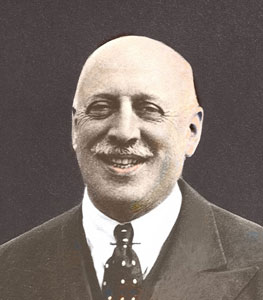
Discover C.H. Douglas’s proposals for economic and social renewal with the Pilgrims of St. Michael in Rougemont, Quebec Canada from Sept. 23 through September 28 2026.
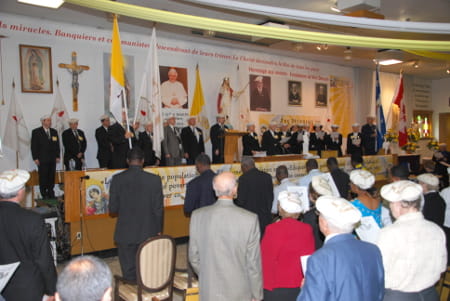
Rougemont Quebec Monthly Meetings
Every 4th Sunday of every month, a monthly meeting is held in Rougemont.

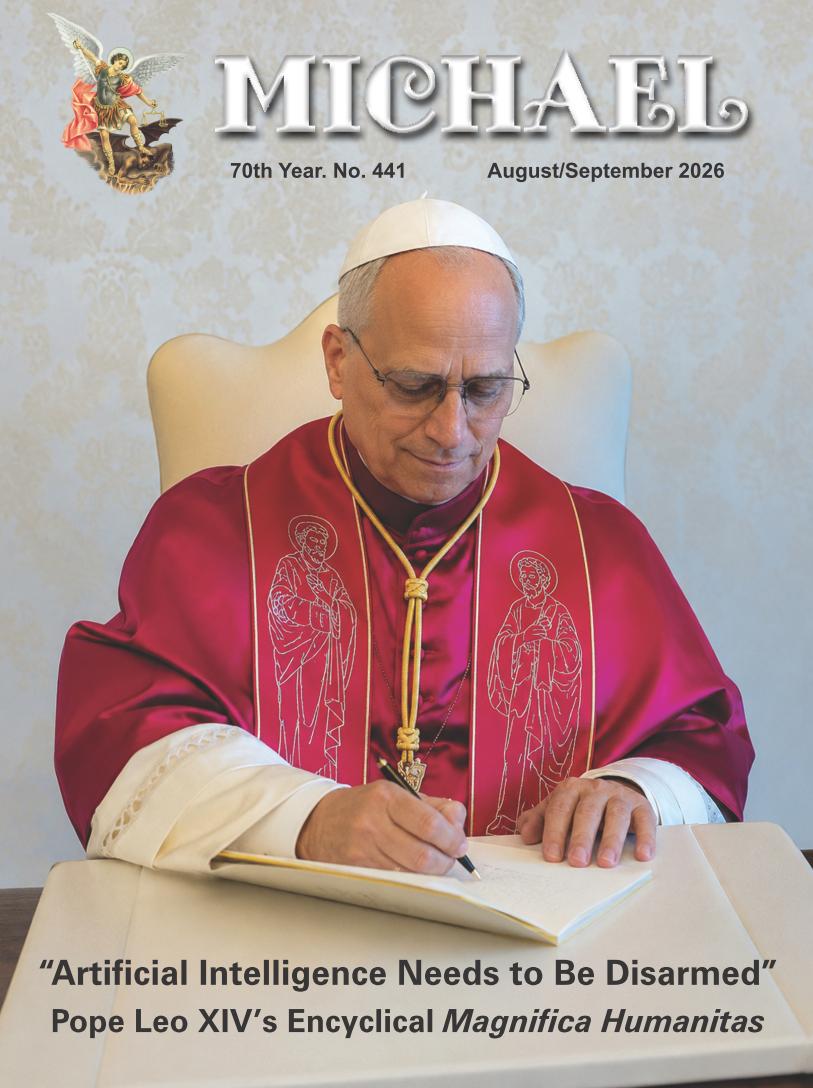 Subscribe