



There are some citizens - too few in number, alas! - who keep themselves well-informed all year long on the state of politics in their country. These people know what is what. When an election comes along they know how to act. They are not tossed this way and that by the flood of oratory, of every shade of opinion, with which the population is deluged during the four to six weeks of campaigning. The readers of our publications are among this group of the well-informed.
During an electoral campaign, meetings are held in every constituency every night and several times on Sunday. More or less large numbers of people attend these meetings. A certain percentage of the audience is composed of the well-instructed group mentioned above, who go there to make known their beliefs, to applaud and encourage the candidate and organisers of their party and to try and persuade others to vote for their candidate.
We don't believe that many conversions are made at these gatherings. Such meetings can only confirm people in their convictions. The majority are there simply because the man of their choice is speaking there.
The great majority of the citizenry doesn't disturb itself too much during the election campaign; some because they already know for whom they'll vote and they're not interested in gaining others to their side; most are inactive because they don't judge it worth the trouble of upsetting their daily routine.
It is on this latter group, this "majority" which sits placidly at home without any deep convictions, that the final vote, from the point of view of numbers, depends. These people don't get out, yet their home is invaded by propaganda, printed, broadcast and televised.
Written propaganda might possibly have little effect on those who read nothing but the sports page, love stories or reports of murders. But the radio hits on all ears and the television picture holds all eyes.
A party such as the National Union party in Quebec supplied with campaign fund ten times greater than that of its opponent, a fund fattened with rake-offs from contracts let without the procedure of bidding, and with our tax money diverted from the uses for which it is legally destined such party can, more easily than the other, mobilize the radio and the television and thus reach that mass of voters, void of any firm conviction, mesmerizing them with words and pictures, and swinging them over for the day of election.
But, the morning after the election, all this ends. This election propaganda is in no way concerned with educating the people in the political activities which take place all year long. Its sole purpose is to capture the votes of those simple people who have little or no interest in public affairs and who are most susceptible to the continual barrage of propaganda beating upon their eyes and ears.
The legislators thus are elected by that section of the populace which is the most impressionable and tractable for that section, at the present time, is in the majority. Those who grind out election propaganda are not concerned with educating the people; they prefer that the masses remain ignorant 46 months out of 48 in order to befuddle and hoodwink them during the two months that precede the election day.
On the evening of June 20, the voting day in Quebec, a commentator said over the radio: "This was not a victory of the National Union party but a victory of the dollar".
How right he was!
The propaganda of "Social Credit" and "Vers Demain" has a completely different end in view. These publications offer to the people a means of instructing themselves at all times so that they may, from their knowledge draw deep and abiding convictions about a cause. This is educational propaganda. For this reason it is carried on the year round.
Though our frontmen were fully committed to the election battle, they did not give up their work of educating. They seized upon every occasion to make their publication better known. Such work was not quite as easy as in normal times. Large crowds were drawn to the meetings indeed; but the Social Credit man had only a small part of the time distributed among a number of speakers, and it was necessary to be there for two or three hours in order to have a mere five to fifteen minutes in which to get across our message to the audience an au- dience excited rather than recollected, an audience more attentive to oratory than to deep reasoning.
Consequently our crusaders are quite happy to return to their normal methods of instruction. It is now, between elections, that they find the time most propitious to increase the number of the informed, to decrease the number of those ignorant and indifferent, easy prey for electioneering propaganda powered by the dollar and having for its end the furthering of private interests rather than the public good.
This paper should be in the hands of every citizen not only to enlighten the citizen and protect him from the poison of election propaganda, but also to show him how to make democracy work elsewhere than in the voting booth where individual worth means nothing and where chicanery and hooliganism make a farce of this game of numbers.
Democracy elects representatives to serve the people. If the elected have lost sight of this principle, if they seek only their own enrichment and renown, then it is for an awakened and determined people to recall it to their minds, to make their voices heard as often and as long as is necessary to make these elected ones take their place in the forefront of the fight to liberate the people from the dictatorship of finance.
Study Session on Economic Democracy And Annual Congress
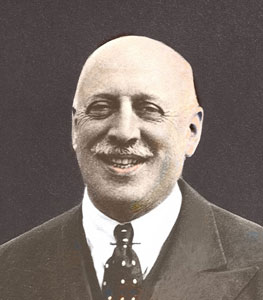
Discover C.H. Douglas’s proposals for economic and social renewal with the Pilgrims of St. Michael in Rougemont, Quebec Canada from Sept. 23 through September 28 2026.
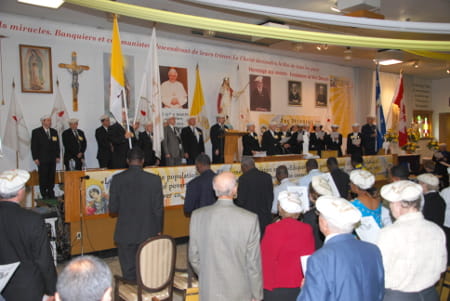
Rougemont Quebec Monthly Meetings
Every 4th Sunday of every month, a monthly meeting is held in Rougemont.

 Subscribe