



Abundance here, poverty there. If you walk along the main street of any of our Canadian cities — Ste Catherine Street in Montreal, Yonge Street in Toronto or Eighth Avenue in Calgary – what would you find to be the chief attraction for all eyes? The store windows, filled with goods of all sorts, arranged with the idea of enticing you inside to buy. And if you go in, salesmen and salesladies use all their skill to make you buy, sparing no pains to lay before you all the wares of the store.
If you were the owner of one of these stores, you would be receiving continually the catalogues of producers; representatives would call upon you each day so that you need never run short of stock or miss any of the multitude of new goods constantly appearing on the market in great abundance.
But then direct your steps along the streets of some of the poorer quarters of these same cities. Go into the houses and visit the families. The impression of abundance which you received from the stores would soon disappear. For here you come face to face with grim poverty. And yet it is here in these homes that human beings have the greatest need of the abundance of goods which fill the shops.
Yes, abundance does exist. But it is rationed. Distribution of these goods is cut to a mere trickle in comparison to the flood which rushes forth from the production system. For distribution is subjected to other conditions than the needs of human beings. It is forced to comply with the terms laid down by Finance, and these terms are such that human needs are forced to go unsatisfied in the face of abundance.
To obtain goods it is necessary to pay for them. In order to pay for goods, you must have money.
In other words, our standard of living depends upon two things: the availability of products to us and money, or purchasing power, in our pockets.
The existence of an abundance of products, as we have said above, is evident on all sides. Products are prompt to answer the call of buyers - more than prompt, in fact, because goods are being produced at such a rate that surpluses are accumulating and producers are being forced to cut down on production thus contributing to the serious unemployment situation. For unemployment means goods produced but not moving; an abundance of goods but a lack of money.
But if, on the one hand we see goods flowing forth from the production line at great speed, we also see, on the other hand, money trickling into our pocketbooks at an agonizingly slow pace. And the proof that the flow of money into the purchaser's pocket does not keep pace with the flow of goods into the stories, is that the buyer's pocketbook is often empty, whereas stores are always filled with good's.
On each product there is a price. What is this price? Look and you will see that it is a figure.
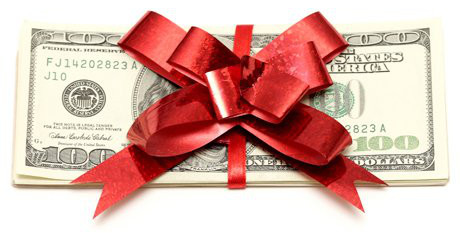
And the money in your pocket (when you have it), what is it? Here again we find that it consists of figures. Take a bill from your wallet, a one, two, five or ten dollar bill. It is a rectangle of paper, approximately six by two and three-quarter inches. That which distinguishes one bill from another, that which differentiates between a one dollar bill and a five dollar bill or between a two and a ten dollar bill, is the figure which is printed on the rectangle of paper. That and the colour. Nothing else. It is not the paper but the figure which makes it money.
If you have an account at the bank it is money; money which you can use to make payment with. But in this case you do not even have these little rectangles of paper. Here you have figures, figures set down by hand in the ledger of the bank. And when you write a cheque to make a payment, the value of the payment by cheque is determined by the figures you inscribe on the cheque. And when your cheque is deposited by the payee, what happens? Figures are changed in his ledger at his bank and are also changed in your account at your bank. These figures are subtracted from your credit and added to the credit of the one to whom you made the payment.
Figures then are used to express the price of goods. Figures make up the money with which you pay for these goods. If the two categories of figures, then, were to balance; if there were as many of these figures in your pocketbook as there were on the price tags of products, goods would no longer pile up on store shelves or in warehouses. And good, strong arms seeking employment would not remain idle as long as there were human needs to satisfy.
But, as everyone knows, such is not the case. There does not exist a balance between price figures and purchasing power figures. Why? Because there is no one, or no organization, charged with the responsibility of effecting and maintaining such a balance.
When the difference between the two categories of figures becomes more marked, that is to say, when prices go up without any corresponding increase in purchasing power, we are accustomed to say: Living is very dear. Which remark does very little to make it cheaper.
And when we look into our pocketbooks, which rarely contain more than enough to meet the essentials of life, we are accustomed to say: "Money is scarce." Which remark again does little to change the situation for the better. What it amounts to, when you think about it, is that what we are saying is: Figures are scarce! And because of this we must remain with our needs unsatisfied even though a multi-million dollar industry (advertising) is importuning us by every means at its disposal to buy from the abundance of goods at hand.
When there exists a vast quantity of goods in a country we say: The country is rich. This is the case with Canada, probably the richest country in the world after the United States of America.
But consider the man who has no money or who has not sufficient with which to live decently. He will say: I am poor.
And there are many who must say: I am poor. I am poor even though the country is rich!
There are those who add: We are poor because there are some who are too rich. Those of us in the Union of Electors, who follow the Social Credit School of Major Douglas, know better than that. We do not say, nor have we ever said, that there are poor because of the rich. We know very well that it is not necessary to deprive the rich of their wealth in order to bring prosperity to the poor. It is easy to prove:
Let us say that you are one of those who normally have little in your wallet. With your thin little pocketbook you go to a store. Now, here is a rich man who enters just in front of you. He sets about making his purchases. He is rich and doesn't have to stint in his buying. He fills a basket, maybe he fills two or three baskets and has several boxes delivered. He pays and exits. Now that he has made his purchases and left, is the store too depleted of goods to furnish you with the things you want for yourself and your family? Not at all! The store is not anywhere near empty. The moment goods start moving off the shelves the clerks replace them with fresh goods from the store's reserves. And if the store owner's reserves begin to run low there are warehouses, full of products, to replenish his stocks.
So it is not the bulging pocketbooks of the rich man which forces you to buy less than you need or to choose inferior products because they are cheaper. It is your own limp wallet: It isn't because he has a lot; it's because you haven't sufficient.
The solution, then, is not to take purchasing power away from the rich. The solution is to give you more purchasing power.
This is the proposal set forth by the distributive economics of Social Credit. Leave the money with those who have it, but make sure that everyone has money, enough, at least, to ensure a decent level of living.
But then where are we going to find the money if we don't take it from those who have money?
Where, in effect, are we going to find those figures of which we spoke above? The answer presents no problem. Legalize figures so that they may be used as money, as the means for paying for the goods. Where is the difficulty?
Is it not a fact that figures were so legalized - and turned into money — by the millions, the hundreds of millions and billions, even during the war? Prior to the war, these legalized figures were lacking to such an extent that the world went through a great crisis known as the Depression. But once launched on a war, these figures came gushing forth, without any difficulty, in the quantities needed. There was no talk of unemployment during the war. These legalized figures were present in abundance, to pay employees, to pay soldiers, to pay for the shells and bombs which were delivered free of charge upon the heads of the enemy.
Which simply proves that any difficulty about producing such figures quickly vanishes once the government has made up its mind to create them. If the government is able to produce such astronomical amounts of these figures in time of war, then surely it can produce enough of them to guarantee a decent living for the country's families during time of peace. What is more, the time of peace would seem to be the most appropriate for producing such figures when hands needed to produce are no longer tied up in the manufacture of instruments of death.
But if you are going to put more money, more of these legalized figures, into the hands of families, does this not mean increasing salaries or wages?
Not necessarily. And it may not even be the best method. Every time you add a dollar to salaries you add a dollar to the cost of production.
A balance could not be achieved by increasing two unequal amounts by equal additions. The means of paying must be increased without increasing prices. So it must be done through some other channel than that of salaries and wages. Such a channel would bring money which would not be a salary, that is, a recompense for employment. A Social Credit economy would call this a social dividend. In France, there are those who term such income, "social revenue". It is a revenue resulting from progress rather than a revenue from work. It is a revenue resulting from mechanization, from automation, It is a revenue to pay for products whose quantity is increased with a decrease in human labor.
Can we, then, without disrupting the established order, thus distribute "unearned" money, money not earned through work? Most certainly. We are doing so even today, even though such distribution is hedged about with conditions which will rapidly disappear, in fact, are beginning to be abolished. We distribute pensions to people of 70 years or more. Such a revenue has no relationship whatsoever with work or employment. It is granted to people of 65 years, and far from tying such a revenue with work, one of the conditions of receiving it is that the recipient, man or woman, be not employed in work. In the United States of America, farmers are paid for reducing the amount of land which they put under cultivation; or they are paid on the condition that they will not raise more pigs. Such distributions of money, far from being tied to employment, are distributed on the condition than no work be performed.
But, you will say, this is money taken from the taxpayers. Family allowances and other like payments are paid out of tax money, and, it will be said, this is precisely why the government refuses to raise family allowance rates to bring them into line with the increases in the cost of living which have occurred since the institution of family allowances.
This objection means nothing when we think in terms of real production, of goods and services, and when the supply of purchasing power in the country is regulated according to the production of the country.
Recall the example we gave above of the rich man who went into a store and bought all he desired without emptying the store. There was no need then to take from the rich man's grocery bag in order to put something in the grocery basket of the poor man. This holds true in the case of family allowances. There is no need to take from the purchasing power of those who have it in order that families may have the means of raising their children as they should be raised. The production system of the country is quite capable of providing 600 or 800 million dollars worth of goods more for our children without in any degree depriving the population of any of the goods and services which it presently enjoys. The unemployed constitute potential production. They are not engaged in production precisely because goods produced are not moving into homes, but are piling up.
Family allowances should immediately be increased by the amount of $15 a month for each child. Families will live better. Merchants will prosper because families are their best customers — when they have money. The farmer, the fisherman, the manufacturer will prosper. Those who are presently barely existing off their unemployment insurance will begin to live decent lives because they will have passed from the ranks of the unemployed to those of the producers.
Money according to the rhythm and flow of production instead of production according to the flow of money; money, legalized figures, in the hands of individuals and families in the amounts which they need to fill their needs and in the amounts compatible with the country's ability to produce such goods; is this not a system logical and humane?
Then why do we cling so grimly to a system which has no other result except to condemn families and individuals to a perpetual nightmare because of the lack of money; which causes such headaches to governments at every level, from municipal to federal? Why? Because egoism, self-seeking at every level of society dominates men and poisons the relationship between men. And one thing is certain; the situation is not going to be corrected through the efforts of existing political parties or the formation of new parties - even if they bear the ticket "Social Credit". For it is of the essence of political parties that men be self-seeking, searching after the first place, after power, willing to devise any scheme to this end, even lying to their fellow-men in order to obtain their votes.
When we consider the problem of distributing the wealth of the earth in a province, or in a country or even in the entire world, it becomes evident that this problem is not only one of techniques but one of human relationships. Only a brotherhood of men will bring an end to an economy of wolves. And to build such a brotherhood we must begin from the milieu in which we live. It will be of no avail to multiply political parties. New parties, from their inception, are affiliated with the same gangrene from which the old ones suffer; they form associations of politicians whose aim is to take, instead of forming apostles whose desire is to give.
A political party, dressing itself up in the habit of Social Credit not only contributes to the worsening of the disease of traditional politics, but adds to the evil by prostituting the name of a doctrine which can only flourish where fraternalism prevails.
Such a fraternity of men is the aim of the members of the Union of Electors. They know that a better world, a world in which men will truly be brothers, can only be instituted where Christ is the foundation stone. And those who labour to build such a society must bring to their task some other spirit than the spirit of self-seeking and the pursuit of honors and profit.
The men who built the marvelous cathedrals of the Middle Ages, considered their work to be an act of faith. They brought to their labour the gift of their time, their strength, their skills, their whole and entire being. They took care to begin their work only when they were in a state of grace, so that each one of their actions would be in line with the high aim of their work. Can we ask anything less of those whose work is to build a better world, a world in which the stones of the edifice are human beings?
Study Session on Economic Democracy And Annual Congress
Discover C.H. Douglas’s proposals for economic and social renewal with the Pilgrims of St. Michael in Rougemont, Quebec Canada from Sept. 23 through September 28 2026.
Rougemont Quebec Monthly Meetings
Every 4th Sunday of every month, a monthly meeting is held in Rougemont.
 Subscribe