



The Catechism of the Catholic Church (CCC), in no. 2309, defines the conditions under which a war is justified, or deemed "just"; the only wars permitted are those involving self-defense:
"The strict conditions for legitimate defense by military force must be rigorously considered. The gravity of such a decision subjects it to rigorous conditions of moral legitimacy. It is necessary that:
-- The harm inflicted by the aggressor on the nation or the community of nations must be lasting, grave, and certain.
-- All other means of putting an end to it must have proved impractical or ineffective.
-- There must be a serious likelihood of success.
-- The use of arms must not cause evils and disorders more serious than the evil to be eliminated. The power of modern means of destruction weighs very heavily in the assessment of this condition.
These are the traditional elements listed in the doctrine known as "just war."
The assessment of these conditions of moral legitimacy is a matter for the prudent judgment of those responsible for the common good."
Therefore, according to the Catechism of the Catholic Church, waging war against Iran to prevent it from obtaining nuclear weapons (what would be called a preventive war in this case) cannot be classified as a just war.
The decisive criterion of the CCC, in n. 2309, is: "The damage inflicted by the aggressor on the nation or community of nations must be lasting, grave, and certain." A potential, future, or hypothetical threat (such as a nuclear program) does not constitute a real and certain armed aggression."
Furthermore, the possession or potential acquisition of a nuclear weapon is not a casus belli (n event or act used to justify a war). The CCC never considers the possession of weapons, military capability, or a nuclear program to be an armed aggression. Catholic doctrine condemns nuclear proliferation, but does not permit attacking a country to prevent it from acquiring nuclear weapons.
Furthermore, the "last resort" criterion is not met. For a war to be just, all nonviolent solutions must have been exhausted: diplomacy, inspections, sanctions, international mediation, and deterrence. In the case of Iran, non-military alternatives still exist. Therefore, the "last resort" has not been reached.
Finally, the criterion of proportionality makes war even less justifiable. The CEC requires that "the use of arms must not produce evils greater than the evil to be eliminated." A war against Iran, a country of 90 million people in a volatile region, with the risk of nuclear or regional escalation, would almost certainly cause greater harm than the threat it purports to prevent.
Study Session on Economic Democracy And Annual Congress

Discover C.H. Douglas’s proposals for economic and social renewal with the Pilgrims of St. Michael in Rougemont, Quebec Canada from Sept. 23 through September 28 2026.
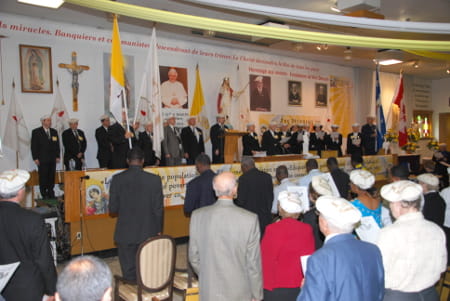
Rougemont Quebec Monthly Meetings
Every 4th Sunday of every month, a monthly meeting is held in Rougemont.

 Subscribe