


There has been the war in Ukraine, now entering its fourth year; the conflicts in Gaza, Sudan, and the Democratic Republic of the Congo, which have claimed thousands of lives; and now, since late February 2026, the attacks by Israel and the United States against Iran.
This latest conflict has captured the world's attention in a particular way because of its global economic repercussions: 20 percent of the world's oil production passes through the Strait of Hormuz, running along the Iranian coast. Since the beginning of this war, the Strait has been blocked, reducing access to oil for many countries around the world, especially China, Japan, and India, and driving up oil prices worldwide.
In addition, 30 percent of global fertilizer trade — vital for worldwide food production — also passes through the Strait of Hormuz. This blockade therefore effectively threatens famine in several African countries and, combined with rising oil prices (essential for transportation), is driving food costs higher.
A catastrophic global upheaval is now unfolding, one that could easily escalate into a Third World War directly involving the major powers, with many even accusing China and Russia of secretly supporting Iran with weapons and strategic intelligence.
In the face of such war madness, one voice has risen in the world to proclaim common sense and reason — the message of peace, the message of the Gospel of Jesus: the voice of the Vicar of Christ, Pope Leo XIV. Many still remember his very first words after his election as the successor of Saint Peter on May 8, 2025:"Peace be with you!... The peace of the Risen Christ — a peace that is unarmed and disarming."
Seeing the urgency of the current situation, the Holy Father has multiplied in recent weeks his public appeals of rare intensity in favour of peace, addressing both the parties involved in the conflicts, governments, and arms dealers. For example, in his Palm Sunday homily on March 29, 2026, he said:
"We turn our gaze to Jesus, who reveals himself as King of Peace, even as war looms around him… Brothers and sisters, this is our God: Jesus, King of Peace, who rejects war, whom no one can use to justify war. He does not listen to the prayers of those who wage war, but rejects them, saying: "Even though you make many prayers, I will not listen: your hands are full of blood" (Is 1:15)… Christ, King of Peace, cries out again from his cross: God is love! Have mercy! Lay down your weapons! Remember that you are brothers and sisters!"
"Let those who have weapons lay them down"
One week later, on Easter Sunday, the Pope delivered the traditional Urbi et Orbi ("To the City and to the World") Easter message from the central balcony of Saint Peter's Basilica. Before extending Easter greetings to the crowd in ten languages, he spoke these words of peace:
Leo XIV blesses the crowd on Easter Sunday
Photo: © Vatican Media
"The power with which Christ rose is entirely non-violent. It is like that of a grain of wheat which, having rotted in the earth, grows, breaks through the clods, sprouts, and becomes a golden ear of wheat. It is even more like that of a human heart which, wounded by an offense, rejects the instinct for revenge and, filled with compassion, prays for the one who has committed the offense.
"Brothers and sisters, this is the true strength that brings peace to humanity, because it fosters respectful relationships at every level: among individuals, families, social groups, and nations. It does not seek private interests, but the common good; it does not seek to impose its own plan, but to help design and carry out a plan together with others…
"In the light of Easter, let us allow ourselves to be amazed by Christ! Let us allow our hearts to be transformed by his immense love for us! Let those who have weapons lay them down! Let those who have the power to unleash wars choose peace! Not a peace imposed by force, but through dialogue! Not with the desire to dominate others, but to encounter them!"
"We are growing accustomed to violence, resigning ourselves to it, and becoming indifferent. Indifferent to the deaths of thousands of people. Indifferent to the repercussions of hatred and division that conflicts sow. Indifferent to the economic and social consequences they produce, which we all feel. There is an ever-increasing'globalization of indifference,'to borrow an expression dear to Pope Francis, who one year ago from this loggia addressed his final words to the world, reminding us:'What a great thirst for death, for killing, we witness each day in the many conflicts raging in different parts of the world!'"
That same Easter Sunday, U.S. President Donald Trump posted the following message on his Truth Social platform, in unusually harsh language:
"Tuesday (April 7) will be Power Plant Day and Bridge Day all rolled into one in Iran. There will be nothing like it!!! There will be nothing like it!!! Open the damn Strait, you crazy lunatics, or you will live in hell — YOU WILL SEE! Praise be to Allah."
In other words, Trump was threatening to destroy all of Iran's power plants and bridges. To make his intentions even clearer, he added: "We are blowing up the entire country" if Iran failed to reach an agreement within forty-eight hours.
On the morning of Tuesday, April 7, Donald Trump continued to maintain suspense by publishing another message on Truth Social: "A whole civilization will die tonight, never to be brought back again," if Iran did not yield before 8:00 p.m. He had previously threatened to "blast Iran into oblivion" and send it "back to the Stone Age." Such statements even raised fears of the possible use of a nuclear weapon.
That same day, following the American president's remarks, Pope Leo XIV, leaving his residence at Castel Gandolfo late in the afternoon, addressed journalists in English and Italian: "Today, as we all know, there is also this threat hanging over the people of Iran, and this is truly unacceptable." He recalled that attacks against civilian infrastructure violate international law and are "a sign of the hatred, division and destruction of which human beings are capable."
The Holy Father described this conflict as an unjust war (see page 16), "which continues to intensify and solves nothing," while worsening the global economic crisis and increasing instability throughout the Middle East. He even directly called upon American citizens to contact their elected representatives in Congress and demand peace — a rare departure from the Vatican's traditional protocol of neutrality, but one he considered necessary in light of the danger of escalation that could lead to a world war. Leo XIV concluded: "Let us return to the table, let us speak, let us seek peaceful solutions, and above all let us remember the innocent — the children, the elderly, and the sick."
Shortly before the expiry of his 8:00 p.m. ultimatum, however, Trump eventually stepped back and announced a two-week ceasefire following mediation efforts by Pakistan. The entire world, which had been holding its breath, could breathe somewhat more easily.
Since the threat of a total war had not disappeared, on Saturday, April 11, the Holy Father invited pilgrims from around the world to gather in Saint Peter's Basilica and Saint Peter's Square in Rome to pray the Rosary to the Virgin Mary and invoke peace. Here are excerpts from his address:
"Now joined in the prayer of the Holy Rosary, as we ask for the intercession of our Mother Mary, we wish to tell the whole world that it is possible to build peace, a new peace; that it is possible to live together with all peoples of every religion and every race; that we wish to be disciples of Jesus Christ, united as brothers and sisters, all united in a world of peace.
"War divides; hope unites. Arrogance tramples upon others; love lifts up. Idolatry blinds us; the living God enlightens. My dearest friends, all it takes is a little faith, a mere "crumb" of faith, in order to face this dramatic hour in history together — as humanity and alongside humanity. Prayer is not a refuge in which to hide from our responsibilities, nor an anesthetic to numb the pain provoked by so much injustice. Rather, it is the most selfless, universal and transformative response to death: we are a people who are already risen!..."
"In the context of the 2003 Iraq war crisis, Saint John Paul II, a tireless advocate for peace, said with deep emotion: "I belong to that generation that lived through World War II and, thanks be to God, survived it. I have the duty to say to all young people, to those who are younger than I, who have not had this experience: "No more war" as Paul VI said during his first visit to the United Nations. We must do everything possible. We know well that peace is not possible at any price. But we all know how great is this responsibility" (Angelus, March 16, 2003). I make his appeal my own this evening, relevant as it is today.
"Prayer teaches us how to act. In prayer, our limited human possibilities are joined to the infinite possibilities of God. Thoughts, words and deeds then break the demonic cycle of evil and are placed at the service of the Kingdom of God. A Kingdom in which there is no sword, no drone, no vengeance, no trivialization of evil, no unjust profit, but only dignity, understanding and forgiveness. It is here that we find a bulwark against that delusion of omnipotence that surrounds us and is becoming increasingly unpredictable and aggressive.
"The balance within the human family has been severely destabilized. Even the holy Name of God, the God of life, is being dragged into discourses of death. A world of brothers and sisters with one heavenly Father vanishes, as in a nightmare, giving way to a reality populated by enemies. We are met by threats, rather than the invitation to listen and to come together. Brothers and sisters, those who pray are aware of their own limitations; they do not kill or threaten with death. Instead, death enslaves those who have turned their backs on the living God, turning themselves and their own power into a mute, blind and deaf idol (cf. Ps 115:4–8), to which they sacrifice every value, demanding that the whole world bend its knee.
"Enough of the idolatry of self and money! Enough of the display of power! Enough of war! True strength is shown in serving life. With evangelical simplicity, Saint John XXIII once wrote: "The benefits of peace will be felt everywhere, by individuals, by families, by nations, by the whole human race." And echoing the incisive words of Pius XII, he added: "Nothing is lost by peace; everything may be lost by war" (Encyclical Letter Pacem in Terris, 116).
Let us, therefore, unite the moral and spiritual strength of the millions and billions of men and women, young and old, who today choose to believe in peace, caring for the wounds and repairing the damage left behind by the madness of war. I receive countless letters from children in areas of conflict. In reading them, one perceives, through the lens of innocence, all the horror and inhumanity of actions that some adults boast of with pride. Let us listen to the voices of children!
Dear brothers and sisters, there are certainly binding responsibilities that fall to the leaders of nations. To them we cry out: Stop! It is time for peace! Sit at the table of dialogue and mediation, not at the table where rearmament is planned and deadly actions are decided! Yet there is a no less significant responsibility that falls to all of us — men and women from all over the world. We are an immense multitude that rejects war not only in word, but also in deed. Prayer calls us to leave behind whatever violence remains in our hearts and minds.
"Let us turn to a Kingdom of peace that is built up day by day — in our homes, schools, neighborhoods, and civil and religious communities. A Kingdom that counters polemics and resignation through friendship and a culture of encounter. Let us believe once again in love, moderation and good politics. We must form ourselves and get personally involved, each following our own calling. Everyone has a place in the mosaic of peace!...
"Dear brothers and sisters, let us return home having made a commitment to pray without ceasing and without growing weary, a commitment to a profound conversion of heart. The Church is a great people at the service of reconciliation and peace. She advances without hesitation, even when rejecting the logic of war may lead to misunderstanding and scorn. She proclaims the Gospel of peace and instills obedience to God rather than any human authority, especially when the inherent dignity of other human beings is threatened by continuous violations of international law. "Throughout the world, it is to be hoped that every community become a'house of peace,'where one learns how to defuse hostility through dialogue, where justice is practiced and forgiveness is cherished. Now more than ever, we must show that peace is not a utopia" (Message for the 59th World Day of Peace, January 1, 2026).
Feeling targeted by these repeated appeals for peace, President Trump, returning to Washington after a weekend in Miami, stopped before cameras and declared: "I'm not a big fan of Pope Leo. He's a very liberal person, and he's someone who doesn't believe in fighting crime." Later that evening, Trump intensified his criticism by posting another strongly worded statement on Truth Social directed at Leo XIV:
"Pope Leo is weak on crime and disastrous on foreign policy. I do not want a Pope criticizing the President of the United States because I am doing exactly what I was elected to do... I do not want a Pope who thinks it is acceptable for Iran to possess a nuclear weapon...
"Leo should be grateful because, as everyone knows, he was not on anyone's list to become Pope, and he was only placed there by the Church because he was American and because they thought it would be the best way to manage President Donald J. Trump. Leo would not be at the Vatican if I were not in the White House."
Trump was therefore implying that it was because of him — rather than the Holy Spirit — that Cardinal Robert Prevost had been elected Pope.
One may wonder why President Trump, who was elected after promising no longer to involve the United States in endless wars, continues to insist that this military intervention against Iran is necessary in order to prevent the country from obtaining nuclear weapons. In fact, this seems rather similar to the argument used by the United States for the war against Iraq in 2003, when President Bush claimed that Iraq possessed weapons of mass destruction, something that later proved to be false.
Furthermore, Joe Kent, former Director of the National Counterterrorism Center, stated on May 7, 2026, that the entire U.S. intelligence community, including the CIA, had concluded prior to the outbreak of the war that Iran was not developing nuclear weapons. According to Kent, U.S. intelligence agencies had also accurately anticipated Iran's response: attacks on American military bases in the region and the closure of the Strait of Hormuz.
Finally, according to an investigation by The New York Times by Jonathan Swan and Maggie Haberman (April 13–14, 2026), Israeli Prime Minister Benjamin Netanyahu and David Barnea, Director of Mossad (Israel's foreign intelligence agency), played a key role in Donald Trump's decision to attack Iran. During a secret meeting in the White House Situation Room on February 11, 2026, Netanyahu reportedly presented Trump with a strategic scenario — including videos, projections, and a Mossad presentation — intended to persuade him that a rapid collapse of the Iranian regime was achievable. This presentation, which reportedly contradicted the more cautious assessments of the CIA, is said to have been a decisive factor in convincing Trump to support Israel's military operation.
Some even suggest that religious beliefs could encourage the United States, Israel, and even Iran to continue this conflict and turn it into a world war. Certain American fundamentalist Christian groups seek to bring about the "Battle of Armageddon," which according to the Bible (Revelation 16:16) will pit Israel and its allies against a coalition of hostile nations, thereby hastening the Second Coming of Jesus after this final war.
Meanwhile, some Jews in Israel believe that their Messiah will appear at the end of such a conflict, while Muslims await a similar figure known as the Mahdi. According to this line of thinking, for those who hold such beliefs, negotiation may appear pointless because they see it as preferable to hasten the end of the world!
On April 13, journalists accompanying Pope Leo XIV aboard the aircraft on his apostolic journey to Algeria and three other African countries naturally asked him about the comments made the previous day by President Trump. The Holy Father replied in English with remarkable calm:
"I am not afraid of the Trump administration. I am not a politician, nor do I intend to enter into a debate with him. The message is always the same: to promote peace. I will continue to speak out loudly against war, to promote dialogue and multilateral relations among states in order to find just solutions to problems. Too many people in the world are suffering today. Too many innocent people are being killed. And I believe someone must stand up and say that there is a better way."
On April 23, 2026, during a press conference aboard the return flight from Africa to Rome, Italian journalist Ignazio Ingrao asked the Holy Father the following question:
"During the Peace Meeting in Bamenda, Cameroon, you described a world turned upside down, where a handful — a minority of tyrants — risks destroying the planet... In light of that, I would like to ask you: negotiations aimed at ending the conflict with Iran remain uncertain and are having major repercussions on the economy. Would you favour regime change in Iran, given that civil society and students have taken to the streets in recent months? And above all, what appeal would you make to the United States, Iran, and Israel to break the deadlock and put an end to this escalation?"
Leo XIV replied: "I would like to begin by saying: we need to promote a new attitude, a culture of peace. Often, when we assess certain situations, the immediate response is: we must intervene through violence, through war, by attacking. As we have seen, many innocent people have died. I have just seen a letter, which you may have seen, written by some of the families of children who died on the first day of the attack. They speak about the fact that they have now lost their boys, their girls — children who have died. And I say: [the question is not] whether this is a regime change; it is not a regime change… The question is how to promote the values we believe in without the deaths of so many innocent people.
"The issue of Iran is obviously very complex. Even the negotiations they have attempted to conduct: one day Iran says'yes,'the United States says'no,'and vice versa, and we do not know where it is leading. And this chaotic situation has developed, creating serious consequences for the global economy. But there is also an entire population in Iran, made up of innocent people, who are suffering because of this war. As for whether this is a regime change or not… it is not clear what regime is actually in place at this moment after the first days of the Israeli and American attacks against Iran. Rather, I would encourage continued dialogue for peace: that the parties commit themselves, that they seek, that they make every effort to promote peace.
"[In the face of] the threat of war, [I say] that international law must be respected. It is very important that innocent people be protected, and that has not happened in various places. I have with me the photograph of a Muslim child who, during my visit to Lebanon, was there waiting with a sign saying:'Welcome, Pope Leo!', and who was later killed during these recent days of war. There are many human situations, and I think we must be able to reflect in this way. As Church, I repeat, as a pastor: I cannot be in favour of war, and I would encourage everyone to make efforts to seek answers that come from a culture of peace rather than from hatred and division."
Then, in English, in response to a question about executions carried out by the Iranian regime, Leo XIV broadened his condemnation so that it would apply to all sides, including implicitly American strikes:
"I condemn every unjust action. I condemn the killing of other people. I condemn capital punishment. I believe that human life must be respected, and that the life of every person — from conception to natural death — must be respected and protected. Therefore, when a regime, when a country makes decisions that unjustly take the lives of other people, it is obvious that this must be condemned."
On May 5, during an interview with conservative host Hugh Hewitt on the American conservative network Salem News Channel, President Trump renewed his criticism of the Pope, saying:
"The Pope prefers to speak as though it were acceptable for Tehran to have a nuclear weapon. I think he is putting many Catholics and many people at risk."
In reality, Leo XIV never stated that Iran should possess a nuclear weapon. That same evening, as he was leaving his residence at Castel Gandolfo, the Holy Father responded as follows to journalists regarding Donald Trump's latest remarks:
"The mission of the Church is to proclaim the Gospel and to preach peace. If someone wishes to criticize me for proclaiming the Gospel, let him do so with the truth: the Church has spoken out against all nuclear weapons for many years, so there is no doubt on this matter. I simply hope to be heard for the value of the Word of God. I have spoken from the very first moment of my election and, now that we are approaching the anniversary, I repeat once again: peace be with you."
The Pope also responded, in English, on the issue of just war: "Since the beginning of the nuclear age, the entire concept of war must be re-evaluated according to present-day realities. I will always believe that dialogue is better than entering into a nuclear conflict."
History teaches us that, at times, a word spoken at the right moment, with the courage not to remain silent, changes the course of events. Leo XIV chose to take that risk — the risk of proclaiming the Gospel and preaching peace. Let us all embrace this message and put it into practice.

Alain Pilote has been the editor of the English edition of MICHAEL for several years. Twice a year we organize a week of study of the social doctrine of the Church and its application and Mr. Pilote is the instructor during these sessions.
Study Session on Economic Democracy And Annual Congress
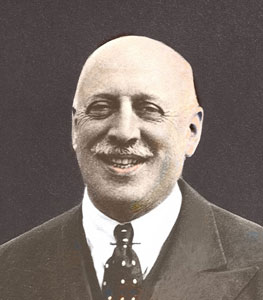
Discover C.H. Douglas’s proposals for economic and social renewal with the Pilgrims of St. Michael in Rougemont, Quebec Canada from Sept. 23 through September 28 2026.
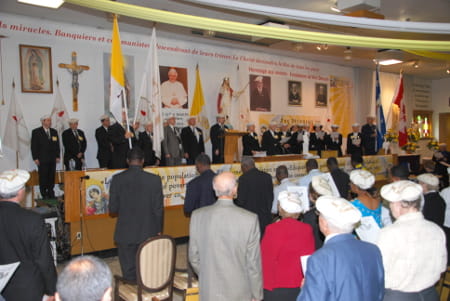
Rougemont Quebec Monthly Meetings
Every 4th Sunday of every month, a monthly meeting is held in Rougemont.

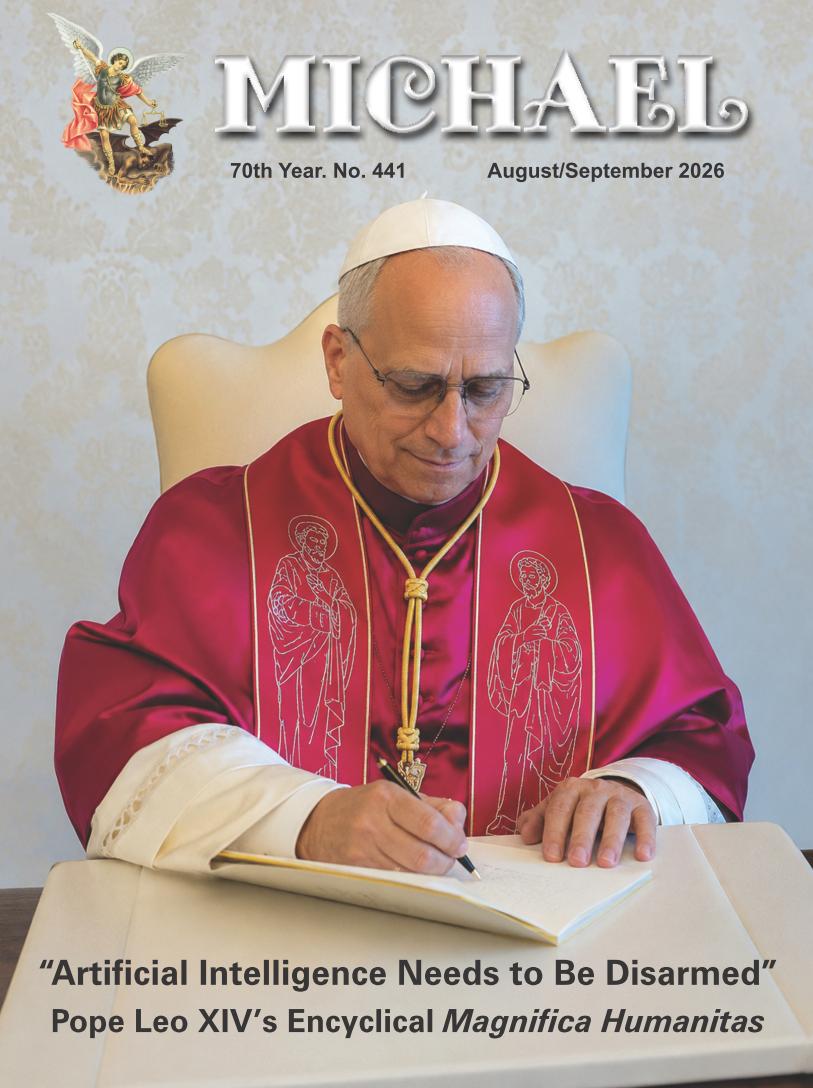 Subscribe