



From April 13 to 23, 2026, the Holy Father made an apostolic journey to four African countries: Algeria, Cameroon, Angola, and Equatorial Guinea. Through their diversity of languages, cultures, and challenges, these countries represented the many realities of the African continent.
African countries face many of the same social and financial difficulties as Western countries. Africans, like Europeans, North Americans, and people on other continents, are all victims of international financiers and bankers. This is why the Holy Father's words are valid and applicable not only to Africa but also to all other countries of the world whose peoples thirst for peace and justice. For example, during the General Audience in Rome on Wednesday, April 29, Leo XIV described the second country he visited, Cameroon, in these words:
"Cameroon is known as "Africa in miniature", because of the variety and richness of its natural environment and its resources, but we can also interpret this expression to mean that the great needs of the entire continent are found in Cameroon: the need for a fair distribution of wealth; the need to provide space for the young, overcoming endemic corruption, that of promoting integral and sustainable development, countering the various forms of neo-colonialism with far-sighted international cooperation."
The average age of the population in African countries is under twenty years old (compared to forty-one years in Canada), making it by far the youngest population in the world. Twenty percent of Catholics worldwide are African, and this percentage will continue to increase in the years ahead. Africa is the continent experiencing the fastest growth in the Catholic population, increasing by more than three percent in a single year.
This is where the future of the Church lies, and this is where people thirst for justice and peace and remain open to the Church's teachings on social justice, as well as practical ways of applying them, including, naturally, the Economic Democracy promoted by Michael Journal and increasingly spreading throughout Africa, even in academic circles.
The Pope concluded his General Audience of Wednesday, April 29, with these words: "Dear brothers and sisters, the Pope's visit is, for the African peoples, a chance to make their voices heard, to express the joy of being God's people and the hope for a better future, of dignity for each and every one. I am happy to have given them this opportunity, and at the same time I thank the Lord for what they have given me, an immeasurable treasure for my heart and my ministry."
It is stated in this issue's editorial of MICHAEL that peace is founded upon justice. Throughout all his speeches in Africa, the Holy Father strongly emphasized these words and the conditions required to put them into practice. This is what we shall discover in the following paragraphs, which present extensive excerpts from his addresses.
Providence arranged that the first of the four countries visited by the Pope would be Algeria, allowing Leo XIV to walk in the footsteps of Saint Augustine, Doctor of the Church and Bishop of Hippo (now called Annaba), Algeria, who taught the search for truth and the dignity of every human being created in the image and likeness of God.
Before becoming Pope, Leo XIV had served for several years as Superior of the Augustinian Order and therefore had a special attachment and devotion to Saint Augustine, who deeply shaped his spirituality.
During his meeting with authorities, civil society, and the diplomatic corps in Algiers on April 13, the Pope declared:
"The one who accumulates wealth and remains indifferent to others is unjust. This view of justice is both simple and radical for it recognizes the image of God in others. Indeed, a religion without mercy and a society without solidarity are a scandal in God's eyes. Yet many societies that consider themselves advanced are plunging ever deeper into inequality and exclusion. Africa knows all too well that people and organizations that dominate others destroy the world, which the Most High has created in order that we might all live together. (…)
"The true strength of a nation lies in the cooperation of everyone in pursuing the common good. Authorities are called not to dominate, but to serve the people and foster their development. Political action thus finds its guiding criterion in justice, without which there can be no authentic peace, and is expressed in the promotion of fair and dignified conditions for all."
On April 15, the Pope addressed the following words at the Presidential Palace in Yaoundé before civil authorities and members of the diplomatic corps:
"We are living, in fact, at a time when hopelessness is rampant and a sense of powerlessness tends to paralyze the renewal so deeply desired by peoples. There is such a hunger and thirst for justice! A thirst for getting involved, for a vision, for courageous choices and for peace! It is my great desire to reach the hearts of all, especially young people, who are called to help shape a world that is more just, including in the political sphere.
"Sixteen hundred years ago, Saint Augustine wrote words that have great relevance today:'Those who rule serve those whom they seem to command; for they rule not from a love of power, but from a sense of the duty they owe to others — not because they are proud of authority, but because they love mercy.'From this perspective, serving one's country means dedicating oneself, with a clear mind and an upright conscience, to the common good of all people in the nation. This includes dedication to both the majority of the population and the minorities, as well as their mutual harmony.
"I called on the human family at the beginning of this year to reject the logic of violence and war, and to embrace a peace founded on love and justice. A peace that is unarmed, that is, not based on fear, threats or weapons, and at the same time disarming, because it is capable of resolving conflicts, opening hearts and generating trust, empathy and hope. Peace cannot be reduced to a slogan: it must be embodied in a way of life that renounces all forms of violence, both personally and institutionally. For this reason, I strongly reiterate: "The world is thirsting for peace… Enough of war, with all the pain it causes through death, destruction and exile!" This cry is intended as an appeal that contributes to the efforts for an authentic peace, prioritizing it over any partisan interest.
"Peace, in fact, cannot be decreed: it must be embraced and lived. It is a gift from God, which unfolds through patient and collective effort. It is everyone's responsibility, beginning with civil authorities. To govern means to love one's own country as well as neighboring countries; the commandment "love your neighbor as yourself" is equally applicable to international relations! To govern means truly listening to citizens, valuing their intelligence and their ability to help build lasting solutions to problems. (…)
"In the face of such generous dedication within society, transparency in the management of public resources and respect for the rule of law are essential to restoring trust. It is time to examine our conscience and take a bold leap forward. Just and credible institutions become pillars of stability. Public authorities are called to serve as bridges, never as sources of division, even when insecurity seems prevalent. Security is a priority, but it must always be exercised with respect for human rights, combining rigor and magnanimity, with particular attention to the most vulnerable. Authentic peace arises when everyone feels protected, heard and respected, when the law serves as a secure safeguard against the whims of the rich and powerful.
"Indeed, in order for peace and justice to prevail, the chains of corruption — which disfigure authority and strip it of its credibility — must be broken. Hearts must be set free from an idolatrous thirst for profit: true profit comes from integral human development, that is, the balanced growth of all the aspects that make life on this earth a blessing."
On April 16, the Holy Father spoke at Saint Joseph Cathedral in Bamenda, in northern Cameroon:
"The masters of war pretend not to know that it takes only a moment to destroy, yet a lifetime is often not enough to rebuild. They turn a blind eye to the fact that billions of dollars are spent on killing and devastation, yet the resources needed for healing, education and restoration are nowhere to be found. Those who rob your land of its resources generally invest much of the profit in weapons, thus perpetuating an endless cycle of destabilization and death. It is a world turned upside down, an exploitation of God's creation that must be denounced and rejected by every honest conscience. We must make a decisive change of course — a true conversion — that will lead us in the opposite direction, onto a sustainable path rich in human fraternity. The world is being ravaged by a handful of tyrants, yet it is held together by a multitude of supportive brothers and sisters! (…)
"Peace is not something we must invent: it is something we must embrace by accepting our neighbor as our brother and as our sister. We do not choose our brothers and sisters: we simply must accept one another! We are one family, inhabiting the same home: this wonderful planet that ancient cultures have cared for across millennia."
On April 17, the Holy Father met with the academic community at the Catholic University of Central Africa in Yaoundé and delivered the following words:
"The greatness of a nation cannot be measured solely by the abundance of its natural resources, nor even by the material wealth of its institutions. No society, in fact, can flourish unless it is grounded in upright consciences, formed in the truth. In this sense, the motto of your university — "In the service of truth and justice" — reminds you that the human conscience, understood as the inner sanctuary where men and women discover themselves drawn by the voice of God, is the very ground upon which just and stable foundations for every society must be laid. To form consciences that are free and endowed with a holy restlessness is a necessary condition for the Christian faith to appear as a fully human proposal. Such a faith is capable of transforming the lives of individuals and of society, of inspiring prophetic change in the face of the tragedies and forms of poverty of our time, and of encouraging a continual search for God that is never satisfied.
"It is indeed within the conscience that moral discernment is formed, by which we freely seek what is true and upright. When the conscience takes care to be enlightened and rightly formed, it becomes the source of a coherent way of acting, directed toward the good, justice and peace.
"In contemporary societies, and therefore in Cameroon too, we can witness an erosion of the moral values that once guided community life. As a result, today there is a tendency to approve casually certain practices that were once considered unacceptable. This dynamic can be explained in part by social changes, economic pressures and political forces that shape individual and collective behavior. Christians, and especially young African Catholics, must not be afraid of "new things." Your university, in particular, can form pioneers of a new humanism in the context of the digital revolution. While the African continent is well acquainted with its alluring aspects, it also knows the darker side of the environmental and social devastation caused by the relentless pursuit of raw materials and rare earths. Do not look the other way: this is a service to the truth and to all humanity. Without this demanding educational effort, passive adaptation to dominant paradigms will be mistaken for competence, and the loss of freedom for progress.
"This is all the more true in light of the spread of artificial intelligence systems, which increasingly shape and permeate our mentality and social environments. Like every great historical transformation, this too calls not only for technical competence, but also for a humanistic formation capable of making visible the logic behind economics, embedded biases and forms of power that shape our perception of reality. Within digital environments — structured to persuade — interaction is optimized to the point of rendering a real encounter superfluous; the otherness of persons in the flesh is neutralized, and relationships are reduced to functional responses. Dear friends, you, however, are real persons! Creation itself has a body, a breath, a life to be listened to and safeguarded. It "groans and suffers" (cf. Rom 8:22), just as each one of us does.
"When simulation becomes the norm, it weakens the human capacity for discernment. As a result, our social bonds close in upon themselves, forming self-referential circuits that no longer expose us to reality. We thus come to live within bubbles, impermeable to one another. Feeling threatened by anyone who is different, we grow unaccustomed to encounter and dialogue. In this way, polarization, conflict, fear and violence spread. What is at stake is not merely the risk of error, but a transformation in our very relationship with truth.
"It is precisely in this sphere that the Catholic university is called to assume a responsibility of the highest order. For it does not merely transmit specialized knowledge, but shapes minds capable of discernment and hearts ready for love and service. Above all, it prepares future leaders, public officials, professionals and other actors in society to carry out with integrity the responsibilities entrusted to them, to exercise their duties with uprightness and to situate their activity within an ethical framework at the service of the common good.
"Dear sons and daughters of Cameroon, dear students, in the face of the understandable tendency to migrate — which may lead one to believe that elsewhere a better future may be more easily found — I invite you, first and foremost, to respond with an ardent desire to serve your country and to apply the knowledge you are acquiring here to the benefit of your fellow citizens. This is the raison d'être of your university, founded thirty-five years ago to form pastors of souls and lay people committed to society: these are the witnesses of wisdom and justice, of which the African continent needs. (…)
"Dear professors, your role is essential. I therefore encourage you to embody the values you wish to impart — above all justice and fairness, integrity, a spirit of service, and a sense of responsibility. Africa and the world stand in need of people who are committed to living according to the Gospel and to placing their talents at the service of the common good. Do not betray this noble ideal! As well as being intellectual guides, be role models whose scientific rigor and personal integrity form the consciences of your students.
"Africa, indeed, must be freed from the scourge of corruption. For young people, this awareness must take root from their years of formation, thanks to the moral rigor, selflessness and coherence of life shown by their educators and teachers. Day by day, lay the indispensable foundations for the building of a consistent moral and intellectual identity. By bearing witness to the truth — especially in the face of the illusions of ideology and passing fashions — you will foster an environment in which academic excellence is naturally united with human uprightness."
On April 18, the Pope spoke in his homily during Mass celebrated at Yaoundé City Airport just before his departure for Angola:
"Jesus draws near to us. He does not immediately calm the storm, but comes to us in the midst of the danger, and invites us, in our joys and sorrows, to remain together with him, like the disciples, in the same boat. He invites us not to distance ourselves from those who suffer, but to draw near to them, to embrace them. No one must be left alone to confront life's adversities. For this reason, every community has the obligation to create and sustain structures of solidarity and mutual aid in which, when faced with crises –– be they social, political, medical or economic –– everyone can give and receive assistance according to their own capacity and needs. The words of Jesus, "it is I," remind us that in a society founded on respect for human dignity, everyone's contribution is valued as important and unique, regardless of the status or position that each one has in the eyes of the world.
"The exhortation "do not be afraid," then, takes on a broader meaning, even at a social and political level, as an encouragement to confront problems and challenges –– particularly those associated with poverty and justice –– together, with a sense of civic and civil responsibility. Faith does not separate the spiritual from the social. Indeed, it gives Christians the strength to interact with the world, responding to the needs of others, especially the weakest.
"The isolated efforts of individuals are not enough for the salvation of a community: instead, what is needed is a communal commitment, which integrates the spiritual and moral dimensions of the Gospel in the heart of local institutions and structures, making them instruments for the common good, and not places of conflict, self-interest or sterile struggles.
People of God living and journeying in Cameroon, do not be afraid! Remain firmly united to Christ our Lord! With the power of his Spirit, you will be the salt and light of this land! Thank you very much."
Upon his arrival in Luanda, the capital of Angola, later on April 18, the Supreme Pontiff addressed the following words to civil authorities and members of the diplomatic corps, referring to the many African countries whose natural resources are exploited by foreign corporations while local populations remain trapped in poverty. In Angola's particular case, the principal natural resource involved is oil:
"You know well that all too often people have looked — and continue to look — to your lands in order to give, or, more commonly, in order to take. It is necessary to break this cycle of interests, which reduces reality, and even life itself, to mere commodities.
"For the entire world, Africa is a reservoir of joy and hope, which are virtues that I would not hesitate to call "political," because her young people and her poor continue to dream and to hope. They are not content with what already exists; they strive to rise above, to prepare themselves for great responsibilities, and to take an active part in shaping their own future. Indeed, the wisdom of a people cannot be stifled by any ideology, and the longing for the infinite that dwells in the human heart is a principle of social transformation far deeper than any political or cultural program. I am here among you, at the service of the finest powers that animate the persons and communities, of which Angola is a rich and vibrant mosaic. I wish to listen to and encourage all those who have already chosen the paths of goodness, justice, peace, tolerance and reconciliation. At the same time, together with the millions of men and women of good will who constitute the primary wealth of this country, I also pray for the conversion of those who choose contrary paths and hinder its harmonious and fraternal development.
"Dear friends, I have mentioned the material riches upon which powerful interests lay their claim, even within your own country. How much suffering, how many deaths, how many social and environmental disasters are brought about by this logic of extractivism!
"Despots and tyrants of both body and spirit seek to render souls passive and passions gloomy; they prefer a populace prone to inertia, docile and subservient to power. For in sadness, we are indeed at the mercy of our fears and imagination; we take refuge in fanaticism, in submission, in the deafening noise of the media, in the glimmer of gold, in the identitarian myth. Discontent, a sense of powerlessness and uprootedness divide us rather than bringing us together. This spreads a climate of estrangement from the public sphere, contempt for the misfortune of others and the negation of all fraternity. Such discord disintegrates the constitutive relationships that each person maintains with oneself, with others and with reality. (…)
"Together, you can make Angola a project of hope. The Catholic Church, whose service to the country I know you greatly esteem, desires to be leaven in the dough and to foster the growth of a just model of coexistence, free from the various forms of slavery imposed by the elite who are laden with much wealth but false joys. Only together can we multiply the talents of this wonderful people, even in the urban peripheries and the remotest rural areas, where life is vibrant and the future of the people is being prepared. Let us remove the obstacles to integral human development, working and hoping together alongside those whom the world has discarded but whom God has chosen. For thus our hope has arisen: "The stone that the builders rejected has become the chief cornerstone" (Ps 118:22), Jesus Christ, the fullness of man and of history. May God bless Angola!"
During his visit to the Shrine of Mamã Muxima on Sunday, April 19, Pope Leo XIV addressed the following words at the conclusion of the Rosary:
"Praying the Rosary, then, commits us to loving every person with a mother's heart — concretely and generously — and to dedicating ourselves to the good of one another, especially the poorest. A mother loves all her children in the same way and with her whole heart, even though each one is different. In the presence of the Mother of the Heart, we too want to promise to do likewise. We strive without measure so that no one may lack love. We also seek to provide the necessities for living with dignity and happiness: that the hungry may have enough to eat, that the sick may receive the necessary care, that children may be guaranteed a proper education, and that the elderly may live their later years in peace. A mother thinks of all these things. Indeed, Mary thinks of all these things, and she also invites us to share in her maternal concern.
"Dear young people, members of the Legion of Mary, brothers and sisters, Our Lady asks us to let ourselves be moved by the sentiments of her heart, so that like her, we may be workers for justice and bearers of peace. Here, a great project is underway: the construction of a new shrine, able to welcome all who come on pilgrimage. Everyone — especially you young people — should take this as a sign.
"For the Mother of Heaven entrusts a great project to you as well: to build a better, welcoming world, where there is no more war, injustice, poverty or dishonesty, and where the principles of the Gospel increasingly inspire and shape hearts, structures and programs, for the good of all.
"It is love that must triumph, not war! This is what the heart of Mary — the heart of the Mother of all — teaches us. Let us set out, then, from this shrine as "messenger angels" of life, bringing Mary's tender embrace and God's blessing to everyone... Dearest friends, let us offer everything to Mary, giving ourselves entirely to our brothers and sisters, and let us joyfully receive, through her intercession, the Lord's blessing, so that we may bring it to everyone we meet. Amen."
April 23, aboard the aircraft returning him from Equatorial Guinea to Rome, a question was put to the Holy Father regarding immigration.
Response of Pope Leo XIV: "The issue of immigration is very complex and affects many countries — not only Spain, not only Europe or the United States: it is a global phenomenon! That is why my answer begins with a question: what is the North doing to help the South, or those countries where young people today see no future and, for this reason, dream of going North? Everyone wants to go North, but often the North has no solution to offer them. Many are suffering.
"The issue of human trafficking is also part of migration. Personally, I believe that a state has the right to establish rules at its borders. I am not saying that everyone should enter without order, sometimes creating, where they go, situations that are even more unjust than those they left behind.
"But having said that, I ask myself: what are we doing in the wealthier countries to change the situation in poorer countries? Why can we not try — both through public assistance and through investments by large wealthy corporations and multinational companies — to change the situation in countries like those we visited during this trip?
"Africa is considered by many as a place where one can go to extract minerals, take its wealth, and enrich others in different countries. Perhaps we should, at a global level, become more committed to promoting greater justice, equality, and the development of these African countries so that their people will not need to emigrate to other countries, to Spain and elsewhere.
"And the other point I would like to address is that, regardless of the circumstances, these are human beings, and we must treat human beings humanely, and not treat them — as often happens — worse than animals. There is a great challenge here: a country may say that it cannot receive more people, but when they arrive, they are human beings and deserve the respect due to every person by reason of their dignity."
Study Session on Economic Democracy And Annual Congress
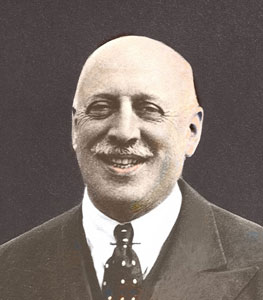
Discover C.H. Douglas’s proposals for economic and social renewal with the Pilgrims of St. Michael in Rougemont, Quebec Canada from Sept. 23 through September 28 2026.
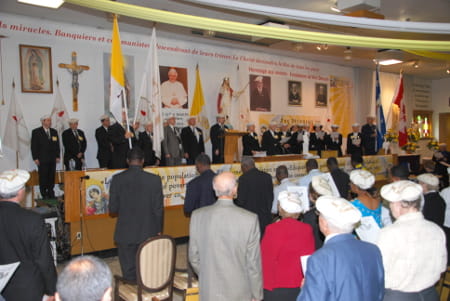
Rougemont Quebec Monthly Meetings
Every 4th Sunday of every month, a monthly meeting is held in Rougemont.

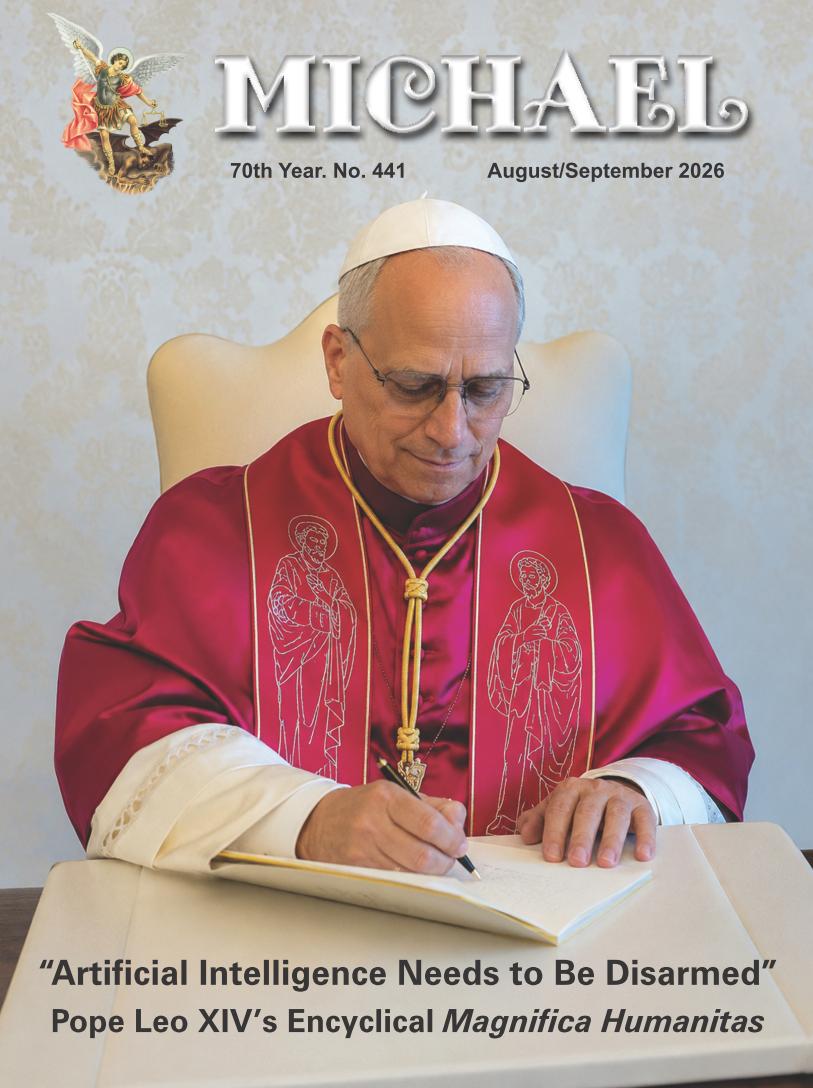 Subscribe