



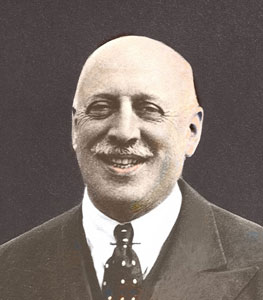
The following article is the first part of the French work, "Pourquoi Taxer ?" by Louis Even, Director-General of the Union of Electors. This pamphlet will be continued in following issues of The Union of Electors until it has been completely published here.
No one really likes taxes. Certainly not those who are obliged to pay them. And those who have to collect them do not do so in order to increase their popularity.
No matter what devices the government may employ from year to year - taking off a tax here, decreasing one there, increasing another, increasing or decreasing the dosage - it will never succeed in satisfying all the vast multitude of tax payers. The proof of this can be found by reading the comments of the various newspapers (excepting those which are obliged to sing the party line of the government) after the Minister of Finance has brought down the annual budget.
Such hostility towards the tax system is not confined to Canada. All civilized countries have adopted taxation as the means of financing administration and public services. And in all civilized countries you will find this general complaint against it. No reform of the taxation system can ever give complete satisfaction.
Pierre Berton writes in a weekly Paris revue (La Grande Relève):
"Everyone seems to be in accord in condemning government financing abuses, its injustices, its disorder, its lack of organization. And whether anyone is aware of it or not, it is the system of taxation which everyone is condemning with complete unanimity. The best and most popular way to effect its reform would be to abolish it."
The manner in which taxes are condemned is in no way an exaggeration. On the contrary, they would be more heartily detested if the people, who do not pay out too much in taxation, were fully aware of the repercussions upon themselves of the taxes, which others pay.
Mrs. X, for example, is not rich. Her husband's salary is too small to be affected in any great way by the income tax rates. Mrs. X pays only the sales tax when she goes shopping for the family. She fumes at the 3 percent or 6 percent sales tax which the merchant charges her. But she says nothing against the 40 percent which she pays because of the taxes paid by the producer, the trucker, the warehouse people, the wholesaler, etc., etc.
Tell Mrs. X that the cost of living is very high. She will be first one to agree with you. But she won't think of blaming anyone but the merchant, or at very most, the manufacturer.
Mr. Y., who is a worker, also fulminates against the high cost of living. The cost of goods and services is practically taking the shirt off his back! But all he can think of blaming is the greed of his boss. It is his salary which is at fault! Neither he nor his union think for a moment of blaming taxation which bears down on the employer just as it does on the worker. The criticism which is levelled at the employer would be better directed against the government!
The first ill effect of taxation is the diminishing of purchasing power. This is something which needs no demonstration to the individual who is affected by the personal tax, such as that on revenue.
The money which you send to the government, or which the government takes out of your pay envelope before you even have a chance to see its colour, this money you no longer possess as your own. You cannot use it to buy something.
Nor is any demonstration needed of this bad effect when you pay the sales tax at the retailer's counter.
A Montrealer who buys a suit priced at $80.00 must pay $84.80 because of the 6 percent sales tax. With this extra $4.80 in his own pocket he could probably have bought a few pair of socks. But the sales tax took away from him the purchasing power which he needed in order to buy these socks.
The housekeeper who protests against the sales tax which is added on to the bill handed her by the merchant, is perhaps not aware that a number of other taxes, much larger than the sales tax, are hidden away in this same bill.
These other taxes manage to avoid their just share of blame because they are invisible. But they cause much more harm than the exposed sales tax.
Take the case of the federal sales tax of 10 percent which is charged at the manufacturers level. 10 percent is already a mighty big fax. But since this tax is imposed at the top of the hill, it gains in size as it rolls downwards towards the level of the ultimate consumer.
If a manufacturer sells a $100 worth of goods to a wholesaler, the latter must pay $110. That is, $100 for the manufacturer; $10 for the federal government.
The wholesaler doesn't raise too much of a hue and cry over this because he is simply going to include the $10 in the price which he will charge the retailer for these same goods. Then too, the wholesaler will add on his margin of profit, say 20 percent. So instead of 20 percent being added on to $100, it is 20 percent added on to $110. That makes $22 additional. Total price: $132.
The retailer, then, must pay the wholesaler $132, whereas he would have paid only $120 without the federal tax. The $10 has already become $12.
Reaching the consumer, after the addition of a succession of percentages, what was $10 at the beginning can very easily wind up being $15 or even more.
But in the bill which is passed to the purchaser this tax never shows. There is only the price. And where the word "price" is concerned the purchaser growls only at the merchant. "Tax" makes him think of the government, 'price' makes him think of the merchant.
When the little people ask that the burden of taxation be transferred to the shoulders of the big, they think they will be protecting themselves. This is a pure illusion. The big set the prices for the little. And make no mistake about it, they include in their prices whatever they are obliged to pay out to the government.
Even when the tax is to be paid only after the sale of the goods like the tax on profits or the tax on the revenues of business men — it is not too difficult for these men to foresee the volume of sales for the coming term and to calculate in advance what price to set in order to make sure that the government will get its share without depriving them of their net profit.
For example, if the Bell Telephone Company wishes to have 14 millions more of profit in order to provide for expansion and improvements, it will calculate its rates in order to have 25 million more instead of just 14 million. Why? Because it knows that on 25 million the government will take 11 million in taxes, which will leave the company, the 14 million it wants. The result: 14 million for the company, 11 million for the government and 25 million for the subscriber... to pay!
Do you believe that the government could sincerely oppose such an increase on the part of the company? The more the company pumps out of the people the greater the government's share. But the subscriber only looks at the rate and throws the blame on the company.
When the big fellows increase their prices by including the tax, the worker does not see the tax. He is not outraged by the tax but rather by the price. And so he asks for an increase in wages. The strength of the union will guarantee such increases, but the increase will be included in the price by the employer and so it is the consumer who ultimately pays. He pays for everything. What the worker gains in salary he loses as a consumer. The spiral is without end.
The solution lies somewhere else. It lies in correcting the financial system which is responsible for generating such taxes.
Tax collection is not restricted to the employees of the Ministry of Revenue or the Ministry of Finance. It reaches down and conscripts as bureaucrats, the manufacturer, employers, merchants, restaurant owners, hotel keepers (for the tax on meals) and even the farmer.
And it causes a considerable waste of time for all in that all are obliged to do considerable accounting work for the government. Each becomes a government tax collector whenever he sells goods or services to his clients in as much as he collects the sales taxes for the government.
Taxes on salaries, at the source, makes of the employer a tax-collector for the federal government.
The provincial sales tax which is in force practically everywhere now, makes of the retail merchant a tax collector for the provincial government or for the municipal government.
The tax on meals makes of the restaurant and hotel owners, collectors of taxes for the provincial government. This extra work - and it is extra work as any of them will assure you - takes them away from other more useful occupations which might increase the value of their services or products. It is as if these poor business men didn't have enough cares and worries from their own businesses, let alone being charged with the government's duties!
With the elimination of taxes and the institution of another means for financing public works and services and other obligations of the various forms of government, the individual business man will be free from the annoyances, the paper work of collecting government taxes. They will be rid of the prying by bureaucrats of the government's tax departments. What a blessing this will be for them! What advantages it will bring to the service they can give the public! One has only to discuss this possibility with these business men to be convinced of this.
(To be continued to the next issue)
Study Session on Economic Democracy And Annual Congress
Discover C.H. Douglas’s proposals for economic and social renewal with the Pilgrims of St. Michael in Rougemont, Quebec Canada from Sept. 23 through September 28 2026.
Rougemont Quebec Monthly Meetings
Every 4th Sunday of every month, a monthly meeting is held in Rougemont.
 Subscribe