



This brief outline of the history of the Social Credit movement in Canada known as the Union of Electors, has been taken from notes prepared by Miss Therese Tardif, secretary of the movement, for a publishing house which wished to use them in one of their publications. Of necessity, this resumé is very brief for a movement which during some 25 years has preached a doctrine rich in truth, which has seen so much activity, fought so many battles, labored so strenuously in an apostolate and accomplished so much. Still, these notes should prove interesting and useful for those who are coming into contact for the first time with the movement; who are hearing for the first time such terms as, "the Institute of Political Action", "Vers Demain", "The Union of Electors". They will also serve to dispell the confusion which has arisen as a result of the existence side by side of the true and authentic Social Credit movement embodied in the Union of Electors, on the one hand, and on the other, of certains groups of politicians who have formed political parties bearing the label "Social Credit", through which parties they hope to acquire personal profit and power.
Louis Even and Gilberte Côté-Mercier (then Miss Gilberte Côté) are the founders of the Union of Electors, the Institute of Political Action and the movement's two publications, Vers Demain (French-language) and The Union of Electors (English-language).
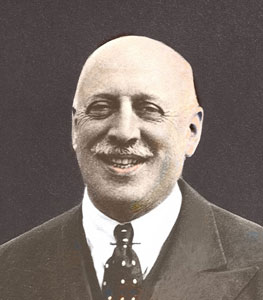
Louis Even first happened upon Social Credit in the Autumn of 1934. At this time he was a teacher of economics for the Gardenvale study club at Ste-Anne-de-Bellevue, a suburb of Montreal. Social Credit, in its more immediate aspects, is an economic doctrine which was given to the world in 1917 by the Scottish engineer-economist, Major C. H. Douglas. Louis Even recognized at once the perfection of this doctrine and he took the decision to devote his time, energy and talent to propagating this doctrine.
Living in the French-Canadian milieu, he decided to begin his work by presenting this doctrine first to the Canadians of the French language. He began by publishing articles in the publication, "Moniteur", which publication is translated from English into French for the Garden City Press. Then, on his own, he began editing and issuing small works on Social Credit which he called Social Credit Notes. He also gave conferences in many of the towns of the province of Quebec.
Gilberte Côté-Mercier holds the degree of Bachelor of Arts from the University of Montreal. She also followed courses leading to licenses, in the faculties of philosophy, Letters and the Sciences of economics and politics at the same University of Montreal. In 1937 she attended a conference on Social Credit given by Mr. Louis Even in Montreal. From that moment she has devoted herself completely to spreading the doctrine of Social Credit in Canada.
In 1939 Louis Even and Gilberte Côté-Mercier founded the publication, Vers Demain. They are the editors of this paper. It appears twice monthly.
The first issue of Vers Demain was dated November 1, 1939. It introduced itself as follows: A journal for political, economic and social orientation.
Vers Demain was founded to teach Social Credit, to form, among the mass of the people, an elite group which, by study, reflection and action would determine the new trends and currents in the flow of history. This group would be the force which would turn the course of politics towards a social order in which man would be capable of reaching his full development.
Vers Demain has reached a circulation of 80,000 readers some 60,000 in Canada. It has readers in 34 other countries of the world. Nor does this paper accept any commercial ads. It is financed solely by the contributions of its readers. No one receives any profit from its publication. All the money received is turned back to the propagation of the movement. Those who do the work of propagation, do so gratuitously!
The English-language paper, The Union of Electors, was founded some two years ago and was the result of previous smaller publications in English. It is the natural outgrowth of the development of the movement. Having penetrated the milieu of French-Canada and established its influence, it was only logical that the movement should begin to spread out among the English-speaking Canadians. While far smaller than its older brother, Vers Demain, this paper is still beginning to make itself felt. Among its readers are many of the men actively engaged in the government of this country, as well as a multitude of professional men.
The institute of Political Action was founded in 1940. It is a group of dedicated individuals who, receiving no remuneration, seek to promote the circulation of Vers Demain and The Union of Electors, enlighten the people, give true direction to politics and defend the poor and the persecuted.
The directors of the Institute, since its foundation, are Louis Even, Gilberte Côté-Mercier and lawyer, J. Ernest Grégoire. Mr. Grégoire is a prominent Quebec city lawyer, a former mayor of that municipality and former M. P. from the constituency of Montmagny. He was professor of political economy at the time of the founding of the Institute of Political Action. He also holds degrees from several European universities.
Other directors at the present time are: Gérard Mercier, a full-time worker in the movement since 1941; Louis-Philippe Bouchard, a full-time worker since 1942, and Hervé Provencher, a full-time worker since 1944.
The group of full-time workers at present is made up of 17 young people who have dedicated themselves entirely to the movement's activities. They travel about the country, begging their lodgings and meals, holding assemblies, visiting Crediters, guiding and encouraging the members of the movement in their work.
The main army of the movement is made up of that multitude of men and women who give their spare time to advance the cause. They spend their weekends going about from door to door soliciting subscriptions to our publications and speaking of the movement. They pledge themselves to take so many subscriptions a week.
All those who regularly take subscriptions to these papers are considered to be members of the Institute of Political Action, since they actively participate in the work of propagating the movement.
This is the movement. Its essence is in this; that it is the formula of policy of the Social Credit movement. It is the totality of all citizens, enlightened and educated by the Institute of Political Action and by the papers, Vers Demain and The Union of Electors, who take their responsibilities seriously and an see to it that their wishes are respected by the civil authorities.
Other means of education
For two years now, the directors of the movement have been giving weekly talks over 22 radio stations in Canada. They are also beginning to be seen and heard over different television stations.
The Institute of Political Action also edits and distributes pamphlets, holds local and regional assemblies and periodically holds grand national congresses.
The Union of Electors demand of the authorities concerned, the realization and application of the principles and ideals of Social Credit: the distribution of a monthly dividend to each Canadian citizen in order that the abundance of production might be shared and each might receive enough to meet the necessities of life; the institution of a compensating discount which will balance prices with purchasing power; the financing of all new production, public and private, through the issuance of credits free of interest charges.
The Union of Electors demands the abolition of taxation. It fights against Socialism and Communism.
The Institute of Political Action counts thousands of individuals amongst its members individuals who fight to defend the poor and the oppressed. Many very special cases have been set right by these elite who work among the people. This movement develops a spirit in the member which is at once patriotic, social and Christian.
If there is no conscription labours in Canada during time of peace, this is due, in part at least, to the unremitting labours of the Union of Electors against conscription.
There has been very considerable advance in the matter of social legislation during these latter years. There are the old age pensions for those arriving at 70 years - no enquiries made; help for needy mothers, etc. The Union of Electors has always striven for such legislation, but always with the proviso that there be no increase in taxation.
The four Premiers of the Maritime provinces have demanded a special commission to investigate the existing monetary system. The premier of Ontario, the Honorable Leslie Frost, has publicly criticized the policies of the Bank of Canada, demanding that it "come down from its ivory tower and accomplish its proper functions". More than 700 municipalities and school commissions have requested that money without interest charges be made available for the execution of public works. A considerable number of heavy loans proposed by municipalities have been blocked, and the increase of taxation halted, through the pressure brought to bear by Crediters working with the people. All of the above mentioned have come to pass in an atmosphere, a climate, which has been developped by the work of the Union of Electors.
But perhaps the most significant work cccomplished by the Social Credit movement which has been built up around Vers Demain and The Union of Electors, is the formation of an ever-growing number of men and women who constitute an elite corps among the mass of the people men and woman who are educated in matters pertaining to economics and politics, who have shouldered their responsibilities as citizens, who have dedicated themselves to action which will redress the grave injustices and inequalities of the day and obliterate those evils which have caused so many to suffer need and hardship in the face of an abundance which could bring the satisfaction of the basic wants of everyone. This is the great contribution of the Institute of Political Action to the formation of a better world the cultivation in the souls of men and women of the spirit of the apostle, the spirit of brotherhood.
Although the Union of Electors was not created to participate in elections, it has, nevertheless, already participated in election campaigns. At a time when the movement was still young and inexperienced, it gave in to the pressure exerted upon it by certain election-minded elements in the group. In 1948 it went so far as to present some 92 candidates in 92 constituencies in the Quebec provincial elections. The results for the movement were exactly nil. Not only that, the fruits of a dozen years of hard apostleship were threatened with annihilation. The true apostles of the movement took up their true work once again with undiminished fervor and zeal. Those election-minded individuals, primarily responsible for the defeat, retired into the shadows to concern themselves with their own private affairs.
Once the movement had recuperated its losses after this electoral disaster, there once more appeared in its ranks individuals who strove to lead the movement back into the field of party politics and elections. They wasted their time. The directors of the movement, and the rank and file quickly put a stop to this move. Thus repulsed, these politicians attempted to profit from the good name of the movement by founding a group called "Ralliement des Créditistes". (literally, "the rally of Social Crediters'). They even attempted to usurp the places held by the directors of the movement. These electioneers are the adversaries of Social Credit. They know very well that in diverting Social Credit towards electioneering they are diverting it from its true end. Such ambitious individuals, pushed on and aided by the true adversaries of Social Credit, are in effect traitors to Social Credit, and they are denounced as such by the Union of Electors.
The Union of Electors exists to give Social Credit to the people, not to give power and profit to ambitious and overbearing individuals.
The political party is the very contrary to Social Credit. Social Credit seeks to put power into the hands of the people. Political parties on the other hand give power into the hands of small groups of individuals. The two are contradictory. The Union of the people (the "union of all electors") tends to make the people powerful. Political parties weaken the power of the people by dividing them.
The Union of Electors, the Institute of Political Action, the two publications, Vers Demain and The Union of Electors, have never been allied in any way with the so-called "Social Credit" parties of Alberta or British Columbia nor with the now-defunct federal group once headed by Solon Low. In 1944, at a convention held in Toronto, the Union of Electors agreed to experiment with a federation of all the different Social Credit movements across Canada, each movement, however, to remain autonomous. Three years later, the Institute disassociated itself completely from this groupment when it became evident that the Union of Electors could best pursue its aims by severing all ties with an organization which, contrary to the principles recognized at Toronto, was more and more gravitating into the field of party politics.
There had been members of parliament in Ottawa, supposedly Social Credit members, for some 23 years. What did they accomplish for Social Credit? Absolutely nothing! Solon Low, himself, once elected chief of the national Social Credit Association, passed from the provincial legislature of Alberta to the House of Commons in Ottawa where he held this seat during 13 years. He accomplished nothing for the wonderfull doctrine of Social Credit. And yet, it was in the name of Social Credit that he was elected. The same can be said about Manning, the "Social Credit" premier of Alberta and of Bennett who holds forth in British Columbia under the name of Social Credit. In their provinces they have done nothing towards establishing a Social Credit regime. Yet they persist in presenting themselves and their followers for election under the name of Social Credit. In fact, they constitute nothing more than a political organization whose aim is to hang on to power as long as it can. They simply find that bearing the name of Social Credit is beneficial when it comes time to vote.
The Union of Electors has no relationship with these politicians. Neither has Vers Demain or the English-language The Union of Electors. Both of these papers bear on their front pages, legends to the effect that they are in no sense of the word associated with political parties. (Material supplied by Miss Thérèse Tardif).
Study Session on Economic Democracy And Annual Congress
Discover C.H. Douglas’s proposals for economic and social renewal with the Pilgrims of St. Michael in Rougemont, Quebec Canada from Sept. 23 through September 28 2026.
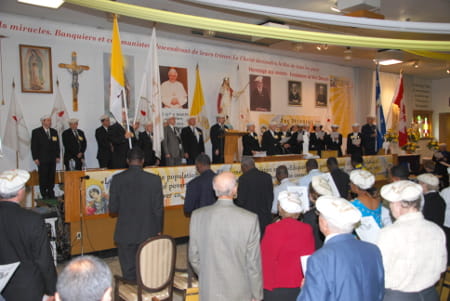
Rougemont Quebec Monthly Meetings
Every 4th Sunday of every month, a monthly meeting is held in Rougemont.

 Subscribe