



All people of good will aspire to peace, yet wars continue to multiply throughout the world, and thousands of innocent people are being killed. The twentieth century witnessed the horrors of two world wars, and what is currently taking place in Iran and the Middle East raises the threat of a third world war that could be even more devastating, since today's weapons are far more powerful and destructive. Can a war be considered "just"? (See page 16.) How can such a catastrophe be prevented?
We read in no. 2304 of the Catechism of the Catholic Church: "Respect for and development of human life require peace. Peace is not merely the absence of war, nor can it be reduced solely to maintaining a balance of power between enemies. Peace cannot be attained on earth without safeguarding the goods of persons, free communication among human beings, respect for the dignity of persons and peoples, and the constant practice of fraternity. Peace is the'tranquility of order'(Saint Augustine). It is the work of justice (cf. Isaiah 32:17) and the effect of charity (cf. Gaudium et Spes 78, §§1–2)."
Peace is not simply the absence of war, but rather "the tranquility of order." What kind of order? An order that allows life in society and respects people in their dignity and rights, founded upon truth, inspired by charity, and sustained by justice.
What is justice? In his Summa Theologica, Saint Thomas Aquinas defines it as "rendering to each what is due to him." We can divide this definition into two parts: what is due to God and what is due to man, to human beings.
What is due to God is the virtue of religion, which consists in giving God the worship, adoration, and obedience owed to Him as Creator and Lord.
What is due to man: because every human being is created in the image of God, each person must receive respect for his or her dignity, truth, fairness, and protection of fundamental rights. In the Decalogue, Commandments 4 through 10 concretely define what each person owes to his neighbour: honour (parents and legitimate authorities), respect for life, respect for purity, respect for the property of others, respect for truth, and respect for interior integrity (not coveting).
To work for peace, therefore, means working for the establishment of justice in the world (see page 10). And for us at Michael Journal, disciples of the school of Economic Democracy founded by Clifford Hugh Douglas and Louis Even, what is due to every human being is a social dividend — a monthly sum of money representing each person's share in the inheritance of natural resources and of progress, including inventions inherited from previous generations.
For us at Michael Journal, justice also requires an honest monetary system that enables people to obtain the goods they need and to "make financially possible what is physically achievable" (see page 4). People should be able simply to make use of available resources, goods, and services without generating impossible debts, making money a representation of realities and permission to obtain them, rather than allowing people to go hungry in the midst of abundance simply because they have no money.
We have spoken of rendering to God and to man what is due to each. This brings to mind the famous words from the Gospel:"Render unto Caesar what belongs to Caesar, and unto God what belongs to God."
Various interpretations have been given to this phrase, particularly the obligation to pay taxes to the government — to "Caesar" — without complaint. Louis Even offered a different interpretation, one that places limits upon Caesar's power and opens new possibilities for liberation from financial problems (see page 6).
Peace is a gift from God that we must ask of Him and can therefore be obtained through prayer. Pope Leo XIV explains this in his plea for peace (see page 11), while also describing during his apostolic journey to Africa (see page 24) the conditions of justice necessary for authentic peace. One particularly effective prayer for obtaining peace is the Rosary of the Virgin Mary (see page 18).
The Virgin Mary desires nothing other than to lead us to her Son Jesus, as she does in all her apparitions. France was especially blessed with Mary's favours during the nineteenth century through several apparitions, including that of Pellevoisin, whose 150th anniversary will be celebrated in 2026 (see page 20).
We must rediscover true values (see page 30) and teach them to our children (see page 17). Enjoy your reading!
Study Session on Economic Democracy And Annual Congress
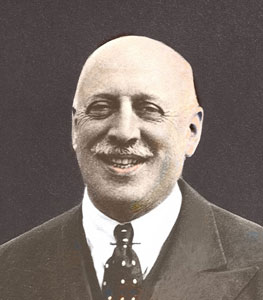
Discover C.H. Douglas’s proposals for economic and social renewal with the Pilgrims of St. Michael in Rougemont, Quebec Canada from Sept. 23 through September 28 2026.
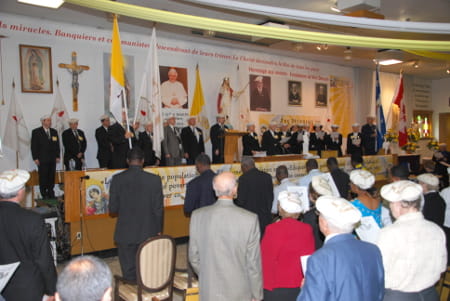
Rougemont Quebec Monthly Meetings
Every 4th Sunday of every month, a monthly meeting is held in Rougemont.

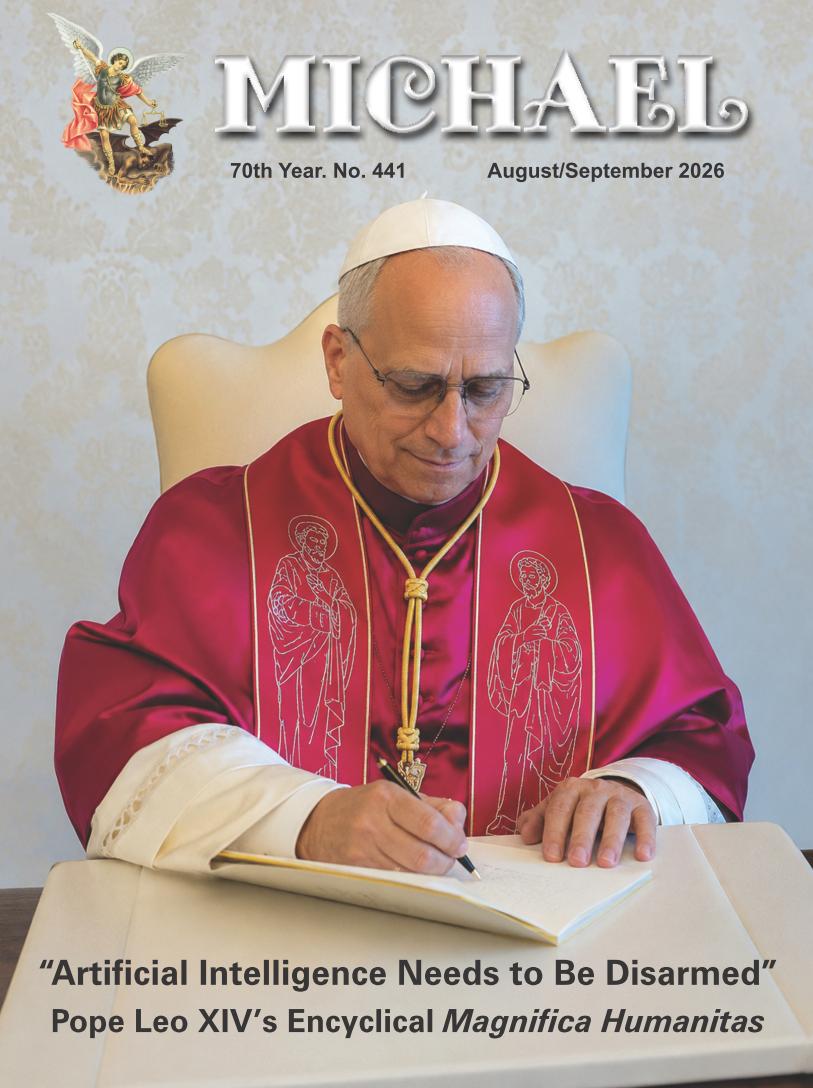 Subscribe