



For some forty years now, and more than ever since the end of the last world war, private enterprise has been blamed for all the evils which have overtaken our economic life. Is there a lack of purchasing power side by side with vast surpluses of all sorts of goods? Then private enterprise, which does a magnificent job of supplying all, and more0 than we need, is made the scapegoat. But finance, whose job it is to furnish the money, and which has failed in this job because of the conditions which it has set, leading to mounting prices, is let off scot-free. We utter not a word against the world-wide and complex system of usury which holds sway over our economic life. But we take the whip to profits which, after all, is to the business man or the undertaker of some system of production what the salary and wage is to an employee of business and industry. And we raise a loud voice in demanding the nationalisation of private business and industry.
The results of nationalisation, where it has been effected, have certainly been anything but brilliant. The stimulus of competition no longer exists; personal responsibility no longer exists; productivity has fallen off; surpluses have been replaced by deficits. These deficits must be made up either by higher prices for goods and services or by taxes. These taxes constitute a burden upon the taxpayer, and since the taxpayer is a consumer, his purchasing power is consequently diminished. Such taxes likewise fall upon non-nationalised enterprises forcing them either to go out of business, thus increasing the number of unemployed, or to increase prices which only serves to bring down upon them further storms of criticism.
All of which can only lead ultimately to the complete socialisation of all production with forced labour, in order that the government may have those revenues which it was no longer able to exact through taxation of private, non-nationalised business. In Canada, propagandists of Socialism, labour union leaders, journalists of the leftist press and those gullible individuals who parrot their teachings - would like to see the governments of this country, federal and provincial, engage in a program of nationalisation such as certain European governments have undertaken. Obviously the balance sheets of such overseas governments have not served as a sufficient warning to the leftists in this country. Has not our own experience here in Quebec with state hospital insurance been that the first result has been a rise in the cost of hospitalisation which is paid for by money taken from the pocketbooks of the citizens?
The Sunday Express (England) of August 16, 1960, gives the case of Mr. Andrew Thomson who, during eleven years, steadfastly refused to accept the money which was profferred him as recompense for the nationalisation of his coal mine by the Labour government immediately after the last war. He judged that the sum was not sufficient. Before nationalisation, Andrew. Thomson employed some 20 miners who were earning 12 pounds sterling each a week. He paid them one shilling more a day than the rate set down by the union. And his mine made money. But, from the end of the very first week of nationalisation, gains diminished and production dropped. At the end of 10 months the mine showed a loss of 10,000 pounds sterling. Today it is closed as "non-producing".
Mr. Thomson refused a cheque of 3,235 pounds for his mine, maintaining that it was worth at that time, 55,555 pounds. Today, he declares, it would be worth, had it been left to him, some 500,000 pounds. The cost of coal, which at that time was 35 shillings a ton, has gone up today to almost 6 pounds a ton (almost 120 shillings, or 4 times what it then cost).
This is but one example. There are others similar - hundreds of them.
In France, the State has already become owner of enterprises which represent a quarter of the French economy. And at this time, the men in government are lending their ears to the proposals of the Socialist party which would double, triple, this proportion.
The following article (translated) by Firmin Bacconnier, appeared in the weekly French publication, Aspects de la France; it underlines the danger of this menace to private enterprise.
"One of the most striking characteristics of the Revolution of 1944-46 (on the emergence from war) is the infiltration of our administrative machinery, by a large number of Marxists dressed up as technicians.
"The aim of these gentlemen: to put the entire economy of France under the direction of a group of irresponsible civil servants.
"One of these bureaucrats of the State is named Alexandre Verret. The revolution of 1944-1946 propelled him into the seat of President and Director-General of Charbonnages de France (the State institution controlling the coal mining industry of France, which had been nationalised. - Ed:)... The State, since the liberation (1945). has become the proprietor of activities representing 25 percent of the French economy. If the proposals of Mr. Verret are realized, this proportion will rise to 75 percent, from whence it will be a short step to 100 percent.
"Naturally, the Socialist Congress had adopted these proposals of the comrade director of Charbonnages de France.
* *
"But here is something that will surprise many people... The party which considers itself to be backbone of the existing system, is not far from espousing the theories of the Socialist party.
"In his commentary on the speeches of General de Gaulle, Mr. Chalandon, former secretary of the U.N.R. (Union pour la Nouvelle République — Ed.), the dominant party in the chamber of deputies, announced very specifically the intention of doing away with private interests and independent enterprise. Our man considers that the State is already master of the big industries and that it would be very easy for it to take over businesses of smaller dimensions. To him it would be sufficient to invite these smaller businesses, by holding out the bait of obvious advantages, to subscribe to contracts for state planning which would bring them, politically, under the control of the Administration. Such contracts would, in effect, bear upon the entire field of production, investments, salaries and prices.
"If we allow these sorcerers' apprentices to go along their merry way, we can be sure that our future will be anything but merry.
"The balance sheet of nationalisation which has been effective since the day after the Liberation, bears out what we have just said. The first result of nationalisation has been to bring deficits to those enterprises which, before their nationalisation, were bringing in profits to their owners.
"Senator Pollenc," who reports the budget, estimates an annual deficit of 200 billion old francs (500 million dollars) in the eight principal, industries which were nationalised: coal mines, railroads; Paris transport; gas, electricity, air-transport, trans-Atlantic transport, and sea transport of goods.
"Furthermore, the deficit is greater, in reality, than that which appears in the round figures furnished us by the accountants. The deficit would appear a great deal more formidable were it not for that fact these State businesses benefited from certain very exceptional tolerances and favors.
"The hidden deficit of these nationalised businesses is very difficult to put into figures, but it would not be exaggeration to say that if they were added to the figures we already have the amount would be astronomical.
"Who covers these deficits incurred by nationalised industries? Quite obviously those businesses which belong to the field of private enterprise and whose disappearance (as private businesses) is desired not only by the Socialists but by the demagogues of the U.N.R.; this deficit is covered by all the taxpayers under the form of accrued taxes; and since such taxes eventually show up in the costs of goods, it is the French consumer who ultimately but very definitely pays the expenses of the policy of nationalisation.
"Our confrere, L'Opinion, has made the following estimate: reckoned in constant francs, the prices of the greater part of the products of private industry have gone down since 1929, whereas those prices which have increased are to be found in the field of nationalised industry. The cost of a kilo of domestic coal has increased; likewise the cost of travelling a kilometre on the railway has gone up.
"Which signifies that nationalisation, that is to say, State control, reduces our economy to a position where it cannot operate except at the cost of rising prices.
"The reason for this trend towards the increase of prices in nationalised production is not difficult to understand. The State is not subject to competition, nor does it concern itself with the cost price. It determines its expenditures for operations according to needs and not according to its resources.
"But when the day arrives that, because of the logical extension of nationalisation to the entire economy, the resources will be reduced to their minimum, how will the State be able to support its needs?
"It will be able to do so only by the institution of forced or obligatory labour, and this is exactly the solution of the Communists.
"Such is the only and certain outcome of the proposals put forth by the Gaulliste, Chalandon and the Socialist, Verret, President and Director-General of the nationalised coal industry of France."
Firmin BACCONNIER
Study Session on Economic Democracy And Annual Congress
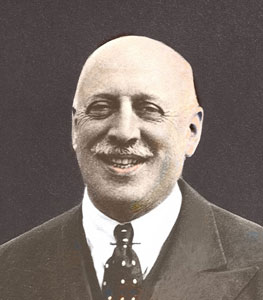
Discover C.H. Douglas’s proposals for economic and social renewal with the Pilgrims of St. Michael in Rougemont, Quebec Canada from Sept. 23 through September 28 2026.
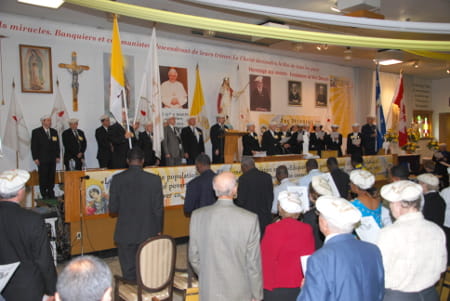
Rougemont Quebec Monthly Meetings
Every 4th Sunday of every month, a monthly meeting is held in Rougemont.

 Subscribe