



Communism is the inevitable outcome of a policy of "full employment". This is the policy universally accepted in every civilized country by every political party, whether its label be Conservative, Labour, Liberal, Socialist or Communist.
"Full employment", implying that if a man will not work neither shall he eat, means that, to obtain money, everyone must work to earn it. But the development of labour-saving devices inevitably means that labour is saved, that more and more can be produced with less and less labour, until ultimately there is not enough work to go around, and at the same time there is a vast accumulation of unsaleable produce.
Only two solutions are then possible; either destruction (e.g. war) or change of policy so that the producers may consume what they produce without any regard to whether or not they work.
If the latter policy is not deliberately adopted, then destruction is inevitable, though it might be postponed by means of strictly enforced restrictions which could not be imposed in an industrial system run by private enterprise. Hence the steady encroachment of great monopolies which ultimately become state owned, the enter prise of the individual is crushed, and Communism prevails.
This might, of course, give peace and security, but only the peace and security of the prison, which would hardly seem to be the proper end for which man has been created.
It is as well to realize the situation, and to make our choice. Meanwhile all who accept the full employment policy are in effect Communists.
W. A. Willox in Credit Notes, Nov. 1960.
Not more than four years ago when the workers of the Union of Electors were beginning to cultivate New Brunswick, they met all sorts of opposition threats of arrest, threats from the people that their auto would be burned if they weren't out of town in ten minutes, etc. In four years, thanks to the undaunted labour of these full-time workers and of the first New Brunswick members of our movement, we are now able to take subscriptions at practically every door we visit in those very places from which formerly we were chased. A little persecution goes a long way!
The world is obsessed, or possessed, by a scarcity complex. While at the date of writing, Great Britain is preparing for another war, she still has a million unemployed, farms going out of cultivation and agricultural products being destroyed because they cannot be sold, publicists still inform us on the one hand that the situation is due to over-production, and on the other hand that sacrifices must be made by everyone, that we must all work harder, consume less, and produce more. (Shades of James Coyne! - Ed.) Yet no economic training is necessary to assess the meaning of the existing situation. On the one hand we have an enormous and increasing capacity to produce the goods and services which are the primary objective of civilization and which probably form the material basis on which alone a cultural superstructure can be reared. On the other hand we have an immense population not only to obtain from the shops, which are so anxious to sell, those goods which they are unable to buy, but are, by the miscalled unemployment problem, prevented from producing still further goods. Ordinary common sense alone seems to be required to recognize that only one thing stands between this practically unlimited capacity to produce and what is in fact a definitely limited capacity to consume, and that is the money system, the bottle-neck which separates production and consumption. The Monopoly of Credit by Major Douglas, pp. 89-90.
Study Session on Economic Democracy And Annual Congress
Discover C.H. Douglas’s proposals for economic and social renewal with the Pilgrims of St. Michael in Rougemont, Quebec Canada from Sept. 23 through September 28 2026.
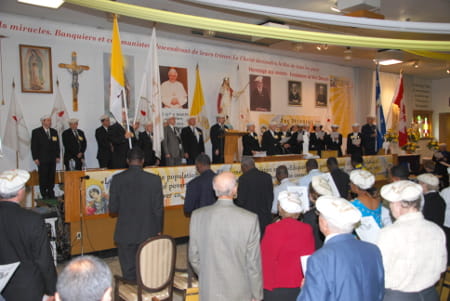
Rougemont Quebec Monthly Meetings
Every 4th Sunday of every month, a monthly meeting is held in Rougemont.

 Subscribe