



- Do you have a bank account?
- Yes. Oh! it's not large; just a few hundred dollars.
- Do you use it sometimes to make payments?
- Yes, when I buy something very expensive or when I order merchandise from a distance. Then I make out a cheque. It's very convenient.
- That's a fact. It's so convenient that more than 90% of commercial transactions are carried out by means of cheques. Not little purchases at the corner grocery, but big deals by wholesalers, industries, transport companies. The cheque is by far and away the chief means of payment today. In comparison to it paper and metal money do practically nothing.
- Yes, but when a cheque is passed it is the bank which pays for the signer. And for the amount of each cheque signed there must be a corresponding amount of paper or silver money which the bank gives to the one presenting the cheque.
- Not any longer, my good man. It requires only a small amount of money to cover a very large number of cheques. The merchant who gets your cheque hardly ever asks the cashier in the bank to give him in cash the amount specified on the cheque. He simply deposits the cheque. The credit in his account increases by the amount of the cheque deposited. Your account, on the other hand, decreases by that amount.
Now, when a merchant orders goods from his supplier he pays for them by cheque. The supplier deposits this cheque at the bank. This time it is the supplier's account which will increase and the merchant's account which will decrease by the amount of the cheque.
All these transactions involve nothing more than the transferring of amounts from one account to another; debiting one account, crediting another.
All in all, for every cheque of $100 there is not more than $10 in paper or silver that passes through the bank. That's the effect of present day business practices; and the banker is well aware of this. As a result the banks are able to lend ten times the amount of money they actually have.
- What's that! How can a banker lend money he doesn't have?
- Simply by creating it. The banks do it with the greatest of ease. They create the money they lend. A banker is essentially a creator of money.
- That's unbelievable! I simply don't understand it!
- Well, my friend, you told me that you had a small account at the bank. Now this account is made up of your savings, isn't it?
- Yes. I brought the money to the bank and deposited it.
- Fine! But there are people who come to the bank without a cent and leave with a bank account many times greater than yours.
- I don't understand.
- No? Well, let's take the example of Mr. Jones, a manufacturer in your town. He wants to enlarge his factory. Everyone think it's a good idea. But Jones hasn't the money to meet the costs of building materials, contractors and machinery. He reckons that with $100,000 he could see the project through. Later, with increased production and sales he could easily repay the $100,000.
What does Jones do? He goes to the bank. He doesn't take any money with him. But when he comes out he has $100,000 in his account.
- That, I can understand. He borrows it.
- Exactly! But the wonderful thing about it is the manner in which the bank makes the loan. If you were a rich man and Jones came to you to borrow, he would get his $100,000 but you would actually have $100,000 less in your account. At the bank it's quite different; Jones goes out with the $100,000 he needed but the bank's cash box isn't short by even one cent!
- You don't say!
- It's the gospel truth. Oh! of course Jones must give sort of security. He has to deposit collateral. Not money because he didn't have any; that's what he came to get. He is perhaps asked for insurance policies or titles to property to the amount of more than $100,000. These are guarantees. Then the manager signs a discounting cheque to the amount of $100,000 for him and sends him to the cashier.
But Mr. Jones doesn't ask for $100,000 in paper or silver money and take it away with him. He deposits the cheque to his account. The sum is credited to him (just as for you in the case of your savings). Mr. Jones leaves the bank with credit on which he can draw by cheque each time he has to pay the contractor as the work progresses. He puts the money into circulation this way. But he must withdraw the money from circulation and pay it all back to the bank at the end of a year.
- And you say the banker hasn't any less money than he previously had?
- Just to convince you, we can go and have a chat with the bank manager. He's a friend of mine and is quite frank with me. Besides he knows I'm acquainted with the details of the Jone's loan and that he won't be violating professional secrecy.
- Mr. Manager, here I am again to tease you about banking as is my habit.
- More questions about credit?
- Yes. It's that loan of $100,000 which you made to Jones. Would you mind telling my friend here exactly what you loaned to Mr. Jones?
- What we lend everyday. Money.
- Certainly. But tell us then, where was this money before Jones entered the bank? Now that's a silly question.
- Not at all. Jones came in without any money. He left with $100,000. Now you got this $100,000 from somewhere. Is some part of the bank short by $100,000?
- Hmmm...!
- Is there $100,000 less in the cashiers' drawers or in the vault?
- Look! He didn't walk out of here with the money in his pocket. It was credited to his account.
- Good. Then some other accounts were depleted to the tune of $100,000. The accounts of some of your clients perhaps?
- That's ridiculous! The clients' money is sacred. Their accounts remain intact unless they make withdrawals from them.
- What! It's not the money of its clients that the bank lends?
- Yes! No! Well, yes and no. In one way, yes; in another, no. We don't touch their money; it's theirs. But that money permits us to lend money to borrowers.
- Then what money do you lend?
- The bank's money.
- But you've just said that not one cent of the bank's money goes out not the client's money either.
- That's right.
- Alright. Now, where were these $100,000 before Jones came into the bank?
- Well, they weren't anywhere. He had to come in and make the loan before they could exist.
- They didn't exist before?
- No.
- And now they do exist?
- Certainly. Because they're there in his account.
- So they came into being the minute Jones got his loan. The bank creates the money it lends.
- Well, I wouldn't like to say that.
- But your big executives have said it quite explicitly. Towers said it when he was governor of the Bank of Canada. Eccles said it when he was the head of the banking system in the United States. Twenty years ago McKenna, then head of the largest commercial bank in England, said it when he was talking to some bankers. So you have no reason to be so scrupulous. The bank creates the money it lends. Furthermore the money has to come from somewhere, doesn't it? The governments all say that it is not they who make money. They're quite satisfied with levying taxes. The workers are quite satisfied to labor and toil. The industrialists are content to produce. And no money ever comes out of their machines. It comes from the pen of the banker.
- We're not criticizing you, Mr. Manager. In fact, we're quite happy that money can come into existence so easily. But what we don't like - and you are no more to be blamed for this than a private soldier is to be blamed for the war - what we don't like is the fact that the banking system considers itself to be the owner of the money it creates. This money really belongs to society.
- Please explain this assertion.
- Just consider the facts. Without a society that produces and has organized itself economically this money would be worth nothing. It's the wealth of a country, its natural resources, the work of its people, the techniques of production, it is all of these things that give some worth to the $100,000 that came out of your pen to Mr. Jones.
- You forget, sir, that Jones deposited first class securities before he got his loan. That is where the $100,000 got their value.
— No, Mr. Manager. The securities deposited by Mr. Jones are a guarantee that he will repay you. If he doesn't, you keep the securities. But, if we had nothing in the land but these securities, if we had no production, no farms, no factories, no transportation, no stores, no economic life, the $100,000 would have no monetary value regardless of how much security Mr. Jones might deposit with you.
It is the entire country, all the wealth of the country, it is the totality of the people of the country which give value to money, regardless of what body or organism creates it. Consequently, by reason of its basic origin, this money in reality belongs to the population of the country. Lend it to Mr. Jones to enlarge his factory if you wish. But the entire country should profit from this loan and not the banks alone. Instead of bringing in interest to the banker, the development of the country should furnish dividends to the people.
We cannot denounce too strongly this, the bank's appropriation of society's credit. It's the biggest racket in history. And the one most firmly entrenched in civilized countries. Its strength and universality in no way justify it. They only make it more odious.
All public debts - municipal, provincial, federal - have their roots in this gigantic swindle. The people build up the country. But this system only plunges them into debt in the same measure as they build.
Public institutions do as Jones did - they borrow. The governments borrow. Their security - bonds, mortgages on our houses, promises to tax the people.
Governments are "small stuff" compared to financial powers.
Only Social Credit can liberate individuals, families and public institutions from this tyranny which has no concern for public welfare.
LOUIS EVEN
Study Session on Economic Democracy And Annual Congress
Discover C.H. Douglas’s proposals for economic and social renewal with the Pilgrims of St. Michael in Rougemont, Quebec Canada from Sept. 23 through September 28 2026.
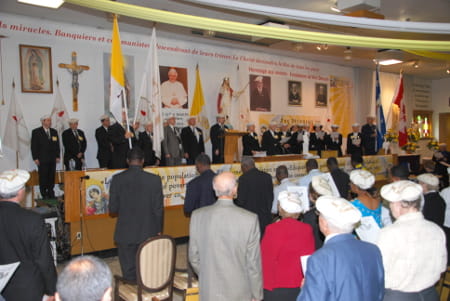
Rougemont Quebec Monthly Meetings
Every 4th Sunday of every month, a monthly meeting is held in Rougemont.

 Subscribe