
The statement that "society is primarily metaphysical" is another way of saying that in the Reality of the Universe, in the Reality of God's creation, material things are subordinate to spiritual matters. It postulates that on the metaphysical plane there is a prototype, which is God's perfect conception of society, and that no society on the material plane will be happy unless it conforms organically to its prototype.
There can be no conscious conformity of the material with the spiritual except by knowledge and acceptance of principles.
The difference between a mechanical thing and something organic is that one is manipulated from without and the other has a life of its own. A primary postulate of Christianity concerning man is that he is a person, that his personality is sacred because it is God's will that it should develop according to its own innate volition in freedom within His Law. In other words, just as man's body is an organism, so is his personality. This is a premise about man as an individual — it is the Christian premise. But man does not live, or attempt to live, merely as an isolated individual; his aim is always to live as an individual person in society.
Basically the battle which is being fought out in the world, and which has reached a crisis in our day, is between those persons who are determined to mould society according to a humanly conceived plan which the Planners shall control and those who, whether instinctively, intuitively or rationally, consciously or unconsciously, want society to conform to its metaphysical prototype, which is God's "plan"; or, to put it another way it is "My Kingdom" which "is not of this world" — a kingdom conceived by God.
Has the Church, "The Mystical Body of Christ," a responsibility to God and society to interpret authoritatively to society the nature of the prototype? There are two statements which indisputably answer this question in the affirmative: one is the injunction "Seek ye first the Kingdom of God" and the other is the warning "What shall it profit a man, if he gain the whole world, and lose his own soul?"
The injunction was followed by a promise that obedience would automatically lead to material blessings, and so is a clear assertion that the Kingdom of God is concerned with this world; and the warning no less so. Concerning these matters there is a passage in Sir David Kelly's book, The Hungry Sheep, which is pertinent. He refers to the practical consequences of the other-worldliness of Oriental religions, to the "passivity, stagnation and squalor — a squalor inconceivable to those who have not travelled East" and affirms that overstressing of the spiritual, subjective side and overdenunciation of the material lead through the loss of balance between matter and spirit to disorder, followed by passive — or grateful — acceptance of lawless arbitrary authority; and ambitious practical people exploit the situation. They exploit it without any restraint, for the religious guides, having given up matter and everyday life as hopeless, can give no lead in practical matters. (Our italics.) This is one reason why arbitrary despotism has been endemic all over Asia, from China to Russia."
It is only too evident that the world, East and West, has become a playground for ambitious practical people; and if there is one thing which should be plain to most people, but clearly isn't, it is that the guidance of spiritual Authority in matters of practical policy in the world is urgently needed. There can be no question at all about the reason for the flight from religious belief in the Western World: it is that Christianity as presented by the Churches has been perverted into an abstraction which is not related to the practical policies pursued in society, and to which it is not intended that it should have any relation. The result is that politics and economics have become divorced from the Truth and are the playground of selfish, power-lusting people who at their worst are determined to gain the whole world and at their best are determined to get a good seat on the band-wagon.
It is against this background that we welcome even the slightest indication of a recognition by the leaders of the Church that they have responsibility to pronounce on Truth in social policies. The statement in his Diocesan Magazine by the Bishop of Oxford (to which, among others, the Bishop of Birmingham, has expressed his "wholehearted agreement") that "Work for work's sake is not a Christian maxim.... freedom from unnecessary work is something to be welcomed....." although not framed expressly as a denunciation of Government policy, which is to find work for everyone regardless of the object of the work and to make it financially difficult for anyone who hasn't a job, has the great merit of stating the Christian doctrine towards an important aspect of social policy, and thus of helping to create a public opinion favourable to a necessary alteration of financial policy to implement the doctrine. This is an important move in the right direction, and the best way to bring the bishops to a sense of their responsibility in these matters is for members of their flock continually to seek guidance from them — guidance which they have a right to expect. The evidence will mount up, and time will show which are God's servants and which are Caesar's. Whose servant is a bishop who refuses guidance?
Meanwhile the Roman Catholic Church shows a more specific realisation of the grave dangers which lie ahead and of the mission of the Church in regard to them. Speaking this month in Rome of "the upheavals in human life" which would come from the peaceful application of the latest scientific discoveries, the Pope said: "It now seems that Almighty God is preparing something truly unusual for the whole of humanity." And Cardinal Leger of Quebec speaking in Montreal referring to automation and its possible consequences, said:
"This means that by 1980, if the social structure is not changed, a few men will possess all the power of production, and humanity altogether will become a herd of consumers.
"And if, on the other hand, this humanity of 1980 has adhered to the ideological programme of Marx, the mass of people, cut away from God, will be nothing more than a pile of flesh debased by pleasure and degraded by surrounding weakness.
"The Church has decided not to permit this fatal disintegration.".
It seems to us that this Catholic prelate has an incorrect view of what will happen under the "ideological programme of Marx," and we are confirmed in the correctness of our view by Sir David Kelly who has had first hand experience of what is actually happening under a Marxist regime. In The Hungry Sheep he writes: "I have never seen anything to compare with the Puritan atmosphere of Soviet Russia; though not yet Orwell's '1984' it is on the way." The degeneracy that is threatened is not the human degeneracy envisaged by Cardinal Leger; it is the inhuman degeneracy of closely supervised automatons under the extreme police State. In any case it is all too evident that the degeneration of human society, and of the individuals which compose it, is in full swing. What are the conditions for a regeneration of human society?
In the first place it is necessary to point to two key factors, the overriding importance of which C. H. Douglas stressed more than a quarter of a century ago.
Firstly: "The Puritan Ideal will have to be faced in the open sooner or later" he wrote in Warning Democracy. It is the Puritan attitude of mind, "the attitude that it is not good for people to have what they want," i.e. someone else must tell them what they want, which has been the chief aberration of mind by which the ugly contagion of Socialism and Communism has been enabled to spread in the world. Until this unChristian attitude of mind is dethroned from its dominating position in society, there cannot be even an approach to an apprehension of what is practically necessary for the regeneration of Christian society.
Secondly: "The factor transcending all others in importance in the modern world is the cultural inheritance by the aid of which wealth in practically unlimited quantity can be produced by a small and diminishing amount of human labour," wrote Douglas in Social Credit. It is this factor which, if accepted in a Christian spirit as a Godgiven gift to humanity, instead of being flouted and rejected by the Puritan governing mind, could have provided for many years past on an increasingly large scale "leisure, meaning by that, freedom from employment forced by economic necessity."
Here are stated the two dominating factors in the situation: on the one hand the dynamic of scientific discovery and applied technics which could be the means to provide the physical basis of a life more abundant, and on the other the unChristian minds of the dominant groups in society who forbid the acceptance of God's gift. The bitter fruits of the policies of these unChristian groups was forecast by Douglas in 1924 with precision: "....if the unemployment problem were solved tomorrow, and every individual capable of employment were employed and paid according to the existing canons of the financial system, the result could only be to precipitate an economic and political catastrophe of the first magnitude, either through the fantastic rise of prices which would be inevitable, or because of the military consequences of an enhanced struggle for export markets."
In the heading of this article we have linked social objectives to social structure, for the reason that social objectives have a vital bearing on social structure. As we have quoted, Cardinal Leger of Quebec has pointed a warning finger at the existing social structure. If society is marshalled, either by persuasion or force, to a communal objective, the social structure that results will be completely the reverse of one which has as its social objective the maximum facilitation and service of individual objectives, which in the nature of Reality, are multifarious. In other words social objectives determine social structure.
The dominant philosophy of the West, the philosophy of the dominant groups (not the dominant philosophy of the bulk of the people), derives from Puritanism and Freemasonry. Its ideal is that of unity, of an imposed harmony, to accord with the plan of an architect. To quote from a book by a Mason, What Masonry Means by William R. Hammond:
"Masons are taught to think of themselves as 'living stones' of a vast social structure. The value of the individual unit lies in its contribution to the larger edifice. Moreover, the nature of the vaster structure is determined by the quality and co-ordination of its numerous parts. Hence its insistence on personal discipline. Each stone must be squared, levelled and plumbed if strength, symmetry and safety are to be known... Similarly, whatever qualifications a person may have his value is negligible if he is not used in, and cannot be adapted to the needs of, the larger social group.".
Here is the determination to create something completely opposed to Reality and completely opposed to the Christian conception of man, as it also is the opposite of an organic conception of society. How then comes it that there is a Bishops' Freemasonic Lodge in the Church of England? The Archbishop of Canterbury is himself a Freemason, and the Archbishop, in common with so many bishops, has shown himself resolutely determined to evade all questions seeking guidance on Christian doctrine in regard either to social objectives or social structure, and determined to uphold the policies of the Masonic groups which dominate the Government of this country. The real question at issue in the Church of England is whether there are enough Christians among the bishops and clergy and whether they have sufficient determination in Christian purpose to overcome the entrenched Puritanism and Freemasonry of the dominant elements. If not, the outlook is bleak for the Church and bleak for England.
We have spoken of the metaphysical prototype of human society and that apprehension of it can only be had by recognition of principles. We believe that only the Church has the psychological power to guide society in the way of this prototype and that this is a fundamental part of its mission on earth. The Bishops of Oxford and Birmingham have given a lead in regard to social objectives which should be vigorously followed up. The basic fact about modern productive methods is that large numbers of people can be released from all economic necessity to earn a living. If this opportunity is accepted the debased commercialism of our times can be completely broken and industrialism severely checked and limited, while an ever-increasing proportion of the population is educated to the creative employment of their time. It is a situation which could enable a wholesale rehabilitation of society in small natural communities, in which craftsmanship would be reborn, unspoilt by commercialism, because the intense economic urge behind commerce would be removed.
"The highest civilisation," said Douglas, "can only be reached by making it impossible for either the State or any other body to apply economic pressure to any individual." The principles which, if adhered to, will produce a Christian social structure are all expressed in Douglas's works. If the Church will create a climate of opinion for the right social objectives, a Christian social structure will follow.
Study Session on Economic Democracy And Annual Congress
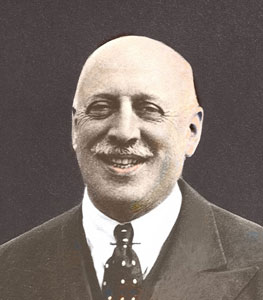
Discover C.H. Douglas’s proposals for economic and social renewal with the Pilgrims of St. Michael in Rougemont, Quebec Canada from Sept. 23 through September 28 2026.
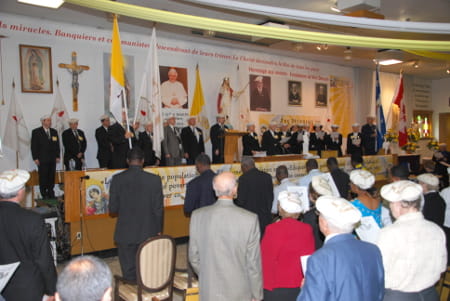
Rougemont Quebec Monthly Meetings
Every 4th Sunday of every month, a monthly meeting is held in Rougemont.
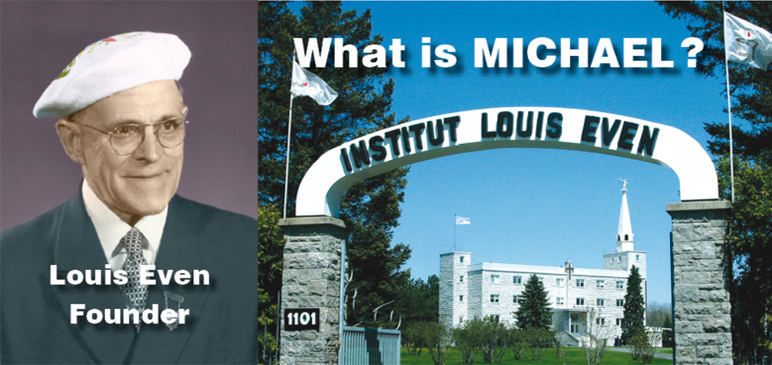
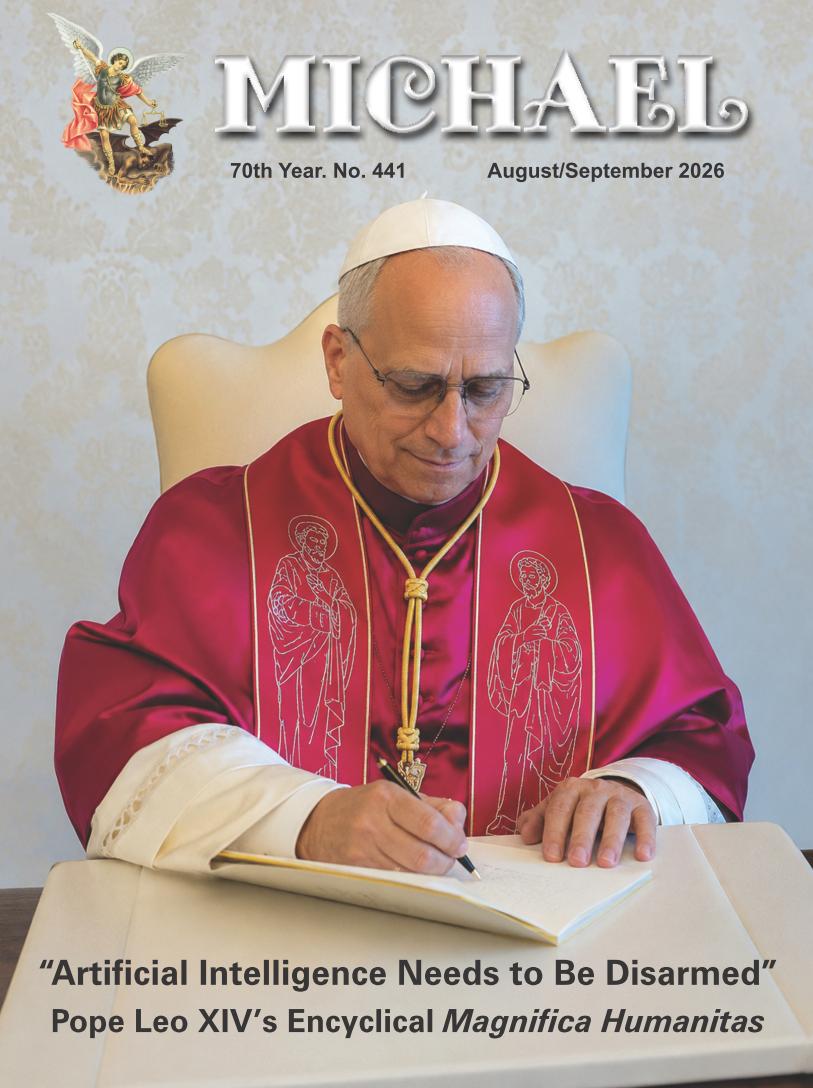
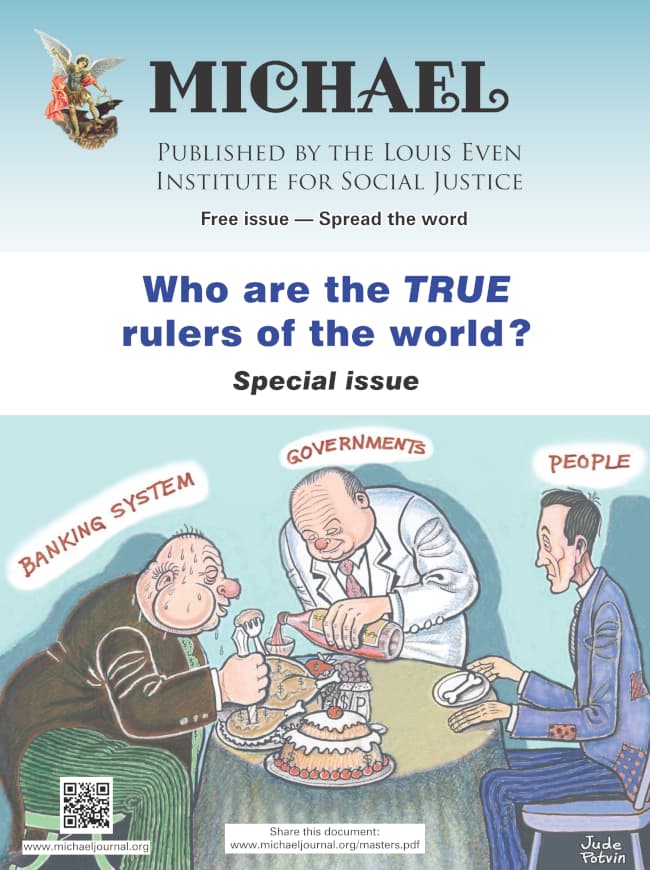 In this special issue of the journal, MICHAEL, the reader will discover who are the true rulers of the world. We discuss that the current monetary system is a mechanism to control populations. The reader will come to understand that "crises" are created and that when governments attempt to get out of the grip of financial tyranny wars are waged.
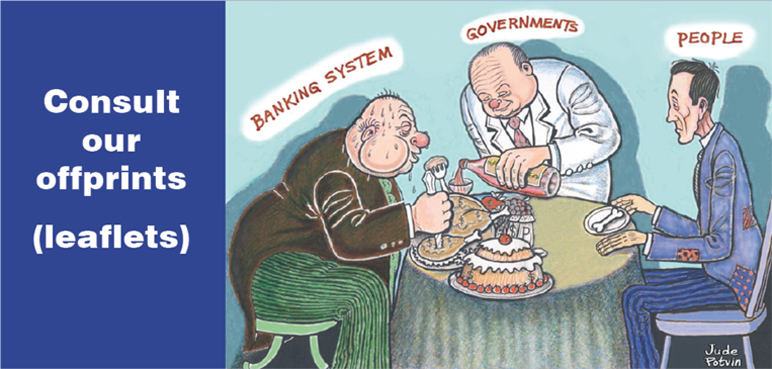
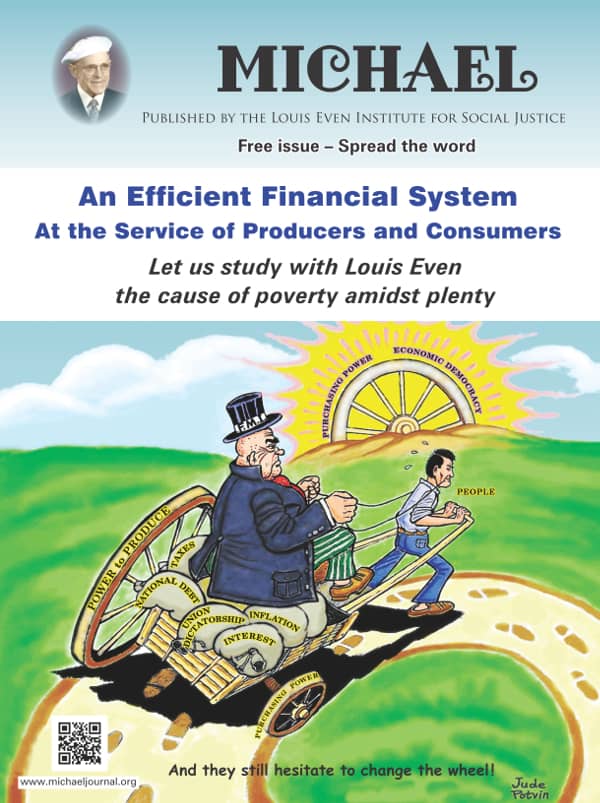 An Efficient Financial System, written by Louis Even, is for the reader who has some understanding of the Douglas Social Credit monetary reform principles. Technical aspects and applications are discussed in short chapters dedicated to the three propositions, how equilibrium between prices and purchasing power can be achieved, the financing of private and public production, how a Social Dividend would be financed, and, finally, what would become of taxes under a Douglas Social Credit economy. Study this publication to better grasp the practical application of Douglas' work.
 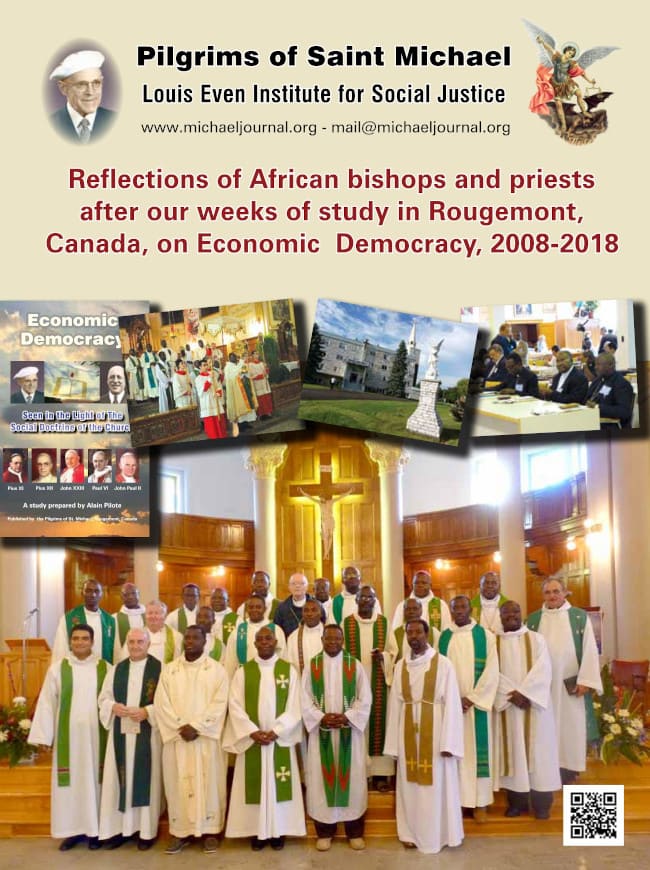 Reflections of African bishops and priests after our weeks of study in Rougemont, Canada, on Economic Democracy, 2008-2018
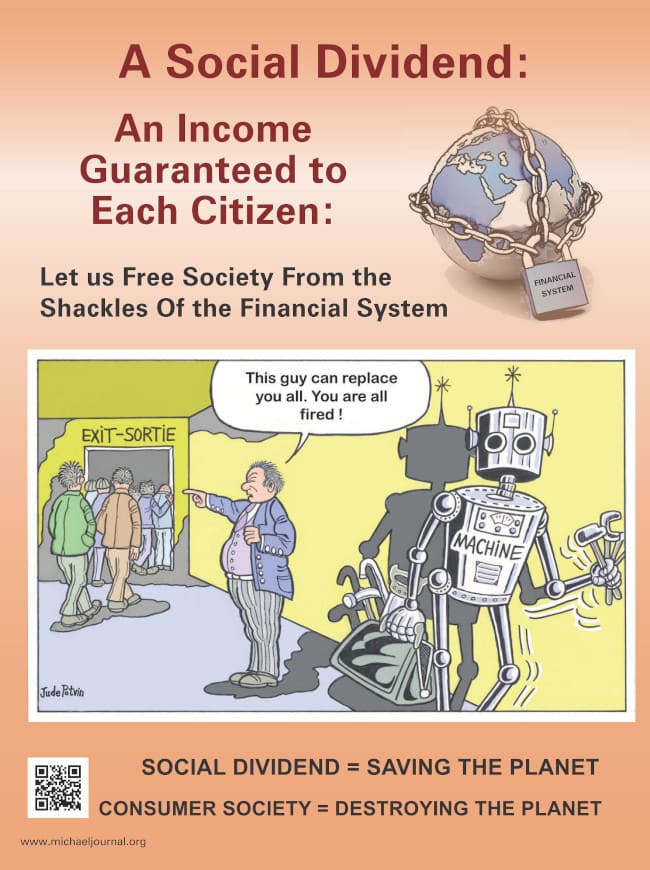 The Social Dividend is one of three principles that comprise the Social Credit monetary reform which is the topic of this booklet. The Social Dividend is an income granted to each citizen from cradle to grave, with- out condition, regardless of employment status.
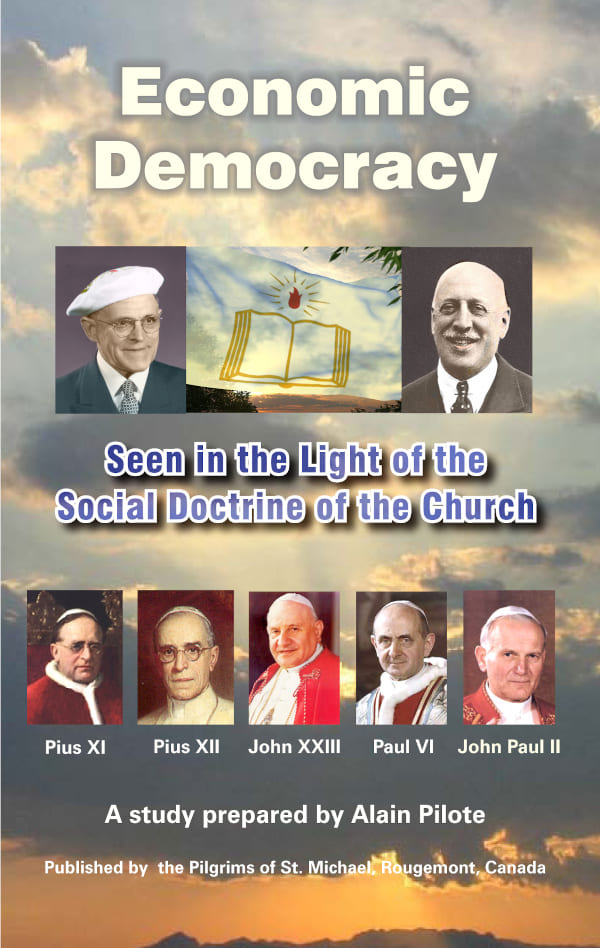 Economic Democracy is a book to explain Social Credit in lessons presented in logical order so it may be easier to the reader to grab the main principles of Social Credit rapidly and somehow easily.
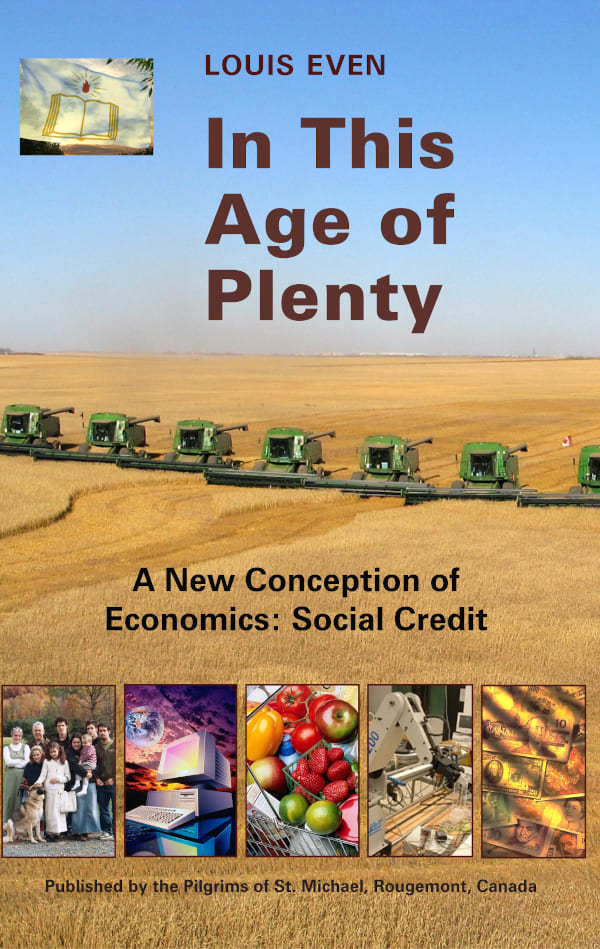 In This Age of Plenty deals with Social Credit, but it does not exhaust the topic. Social Credit principles address social and political matters, as well as, or even more so, than economics and will put civilization on a new course.
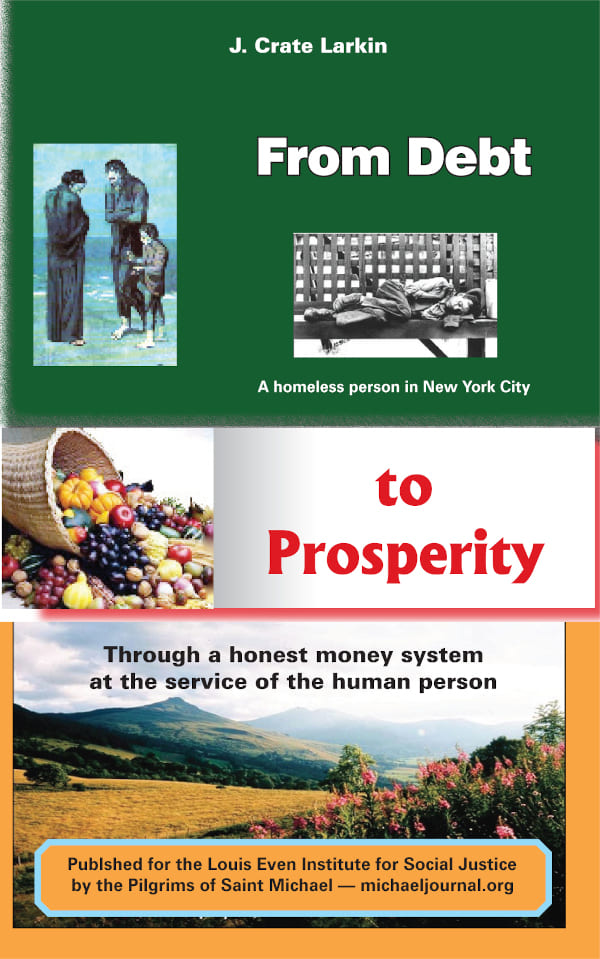 From Debt to Prosperity outlines briefly the economic analysis and constructive proposals known as Social Credit.
 Subscribe