
Our examination of economics and finance to date has established the following points:
1. That, as a result of vast natural resources and a heritage of invention, power driven machines and semi-automatic factories, we live in an age of unparalleled physical abundance. The age old problem of Production has been solved.
2. That this abundance cannot, in today's complex society, reach the consumer without the use of "money".
3. And that today the creation and control of our 'money' — the expansion and contraction of financial credit — rests in the hands of a private monopoly, neither geared to the productive capacity of society and physical realities, nor responsible to the will of the people.
We also examined the way in which the private banking system creates or manufactures, out of paper and ink and against the borrowers' security, the major part of our money supply today, Thus our supply of money and financial credit — the very life-blood of production, trade, industry and consumption — is dependent upon policies controlled by a few powerful financial tycoons and institutions.
The great danger of this policy was obviously understood by our Prime Ministers of the depressed 1930's. The Rt. Hon. R. B. Bennett, as Prime Minister, in an address at Kingston to the students of Queen's University, asked the following quesion:
Why, with a superabundance of the products of the earth, the factories, fuel, power, highways and railways at our disposal, are so many suffering from an insufficiency of the things of life? We have come to realize that this is the most urgent of our problems.
And the Rt. Hon. W. L. Mackenzie King, speaking as Leader of the Opposition in our House of Commons in the 1930's, warned:
Once a nation parts with the control of its currency and credit, it matters not who makes the nation's laws. Usury, once in control, will wreck any nation. Until the control of the issue of currency and credit is restored to the government and recognized as its most conspicuous and sacred responsibility, all talk of the sovereignty of parliament and democracy is idle and futile.
In an earlier issue we discussed the manner in which the international bankers, at that time centred in London, turned the prosperity of the Thirteen Colonies in America into depression by contracting their financial credit or "money" supply, and how this action caused the resentment and bitterness which set the stage for the American Revolution.
Soon after the Colonies gained their independence, however, through bribery and corruption the control of the nation's financial credit was turned over to a private monopoly controlled by the Rothschild interests. And it was Thomas efferson who warned:
I believe that banking institutions are more dangerous to our liberties than standing armies. Already they have raised up a money aristocracy that has set the government at defiance. The issuing power should be taken from the banks and restored to the people to whom it properly belongs.
Abraham Lincoln, shortly before his assassinion (!) warned his people:
"I see in the near future a crisis approaching that unnerves me and causes me to tremble for the safety of my country: corporations have been enthroned, an era of corruption in high places will follow, and the money power of the country will endeavor to prolong its reign by working upon the prejudices of the people until the wealth is aggregated in a few hands, and the Republic is destroyed."
Because we learn little of banking practise in school, and it comes as a shock to many to read that "money" is created out of ink and paper by private institutions, let us now study a few excerpts of evidence given by oustanding bankers themselves on this subject.
William Patterson, founder of the Bank of England (1694):.
"The Bank hath benefits of interests on all moneys which it creates out of nothing."
R. G. Hawtrey, Assistant Secretary of the Treasury of Great Britain, March 22, 1932:
"I agree with Douglas that Banks create money, and that trade depression arises from faults in the Banking System in the discharge of that vital function."
Reginald McKenna, Chairman of the Midland Bank (England), speaking to the shareholders on January 25, 1924:
"I am afraid the ordinary citizen will not like to be told that the banks can, and do, create money. The amount of money in existence varies only with the action of the banks in increasing and decreasing deposits and bank purchases. Every loan, overdraft, or bank purchase creates a deposit; and every repayment of a loan, overdraft, or bank sale destroys a deposit."
The Report of the MacMillan Committee (England), 1929, page 34:.
"... But the bulk of the deposits arise out of the action of the banks themselves, for by granting loans, allowing money to be drawn on an overdraft, or purchasing securities, a bank creates a credit in its books which is equivalent to a deposit."
The Carter H. Harrison Company, Investment brokers of Chicago, in urging their clients to buy bank stocks, say:
"It is essential only to realize that all banks create, out of nothing, the money they lend, even to the government."
H. D. McLeod, in The Theory and Practice of Banking:
"The essential and distinctive feature of a bank and a banker is to create and issue credit payable on demand, and this credit is intended to be put into circulation and serve all the purposes of money. A bank, therefore, is not an office for the borrowing and lending of money, it is a manufactory of credit."
The financial publication, Branch Banking, July, 1938:
"There are enough substantial quotations in existence to prove to the uninitiated that Banks do create credit without restraint and that they create the means of repayment within themselves."
Graham Towers, then head of the Bank of Canada, testifying before the Standing Committee on Banking and Commerce (Ottawa) in 1938:
Question: "But there is no question about it that banks create the medium of exchange?"
Towers: "That is right. That is what they are for... That is the Banking business, just in the same way that a steel plant makes steel.". (p. 287.)
"The manufacturing process consists of making a pen-and-ink or typewritten entry on a card or in a book. That is all." (pp. 76 and 238.)
"Each and every time a bank makes a loan (or purchases securities), new bank credit is created — new deposits brand new money." (pp. 113 and 238.)."
"Broadly speaking, all new money comes out of a Bank in the form of loans." (p. 461.)
"As loans are debts, then under the present system all money is debt." (p. 459.)
Encyclopedia Britannica, under "Money":
"Banks lend by creating credit; they create the means of payment out of nothing."
(To be continued)
Study Session on Economic Democracy And Annual Congress
Discover C.H. Douglas’s proposals for economic and social renewal with the Pilgrims of St. Michael in Rougemont, Quebec Canada from Sept. 23 through September 28 2026.
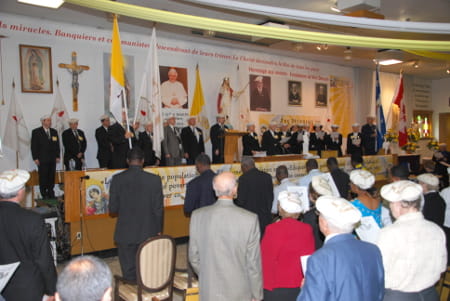
Rougemont Quebec Monthly Meetings
Every 4th Sunday of every month, a monthly meeting is held in Rougemont.
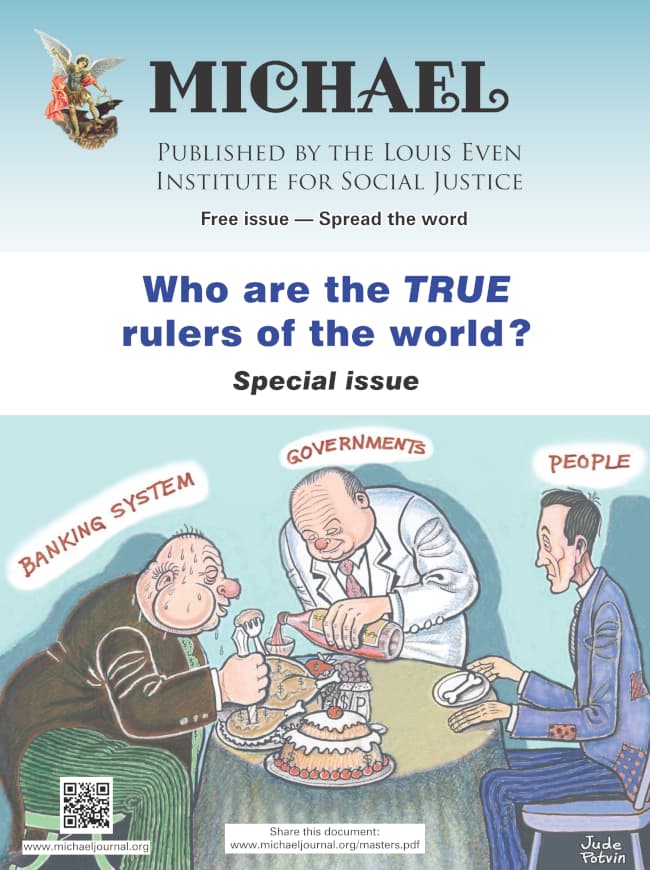 In this special issue of the journal, MICHAEL, the reader will discover who are the true rulers of the world. We discuss that the current monetary system is a mechanism to control populations. The reader will come to understand that "crises" are created and that when governments attempt to get out of the grip of financial tyranny wars are waged.
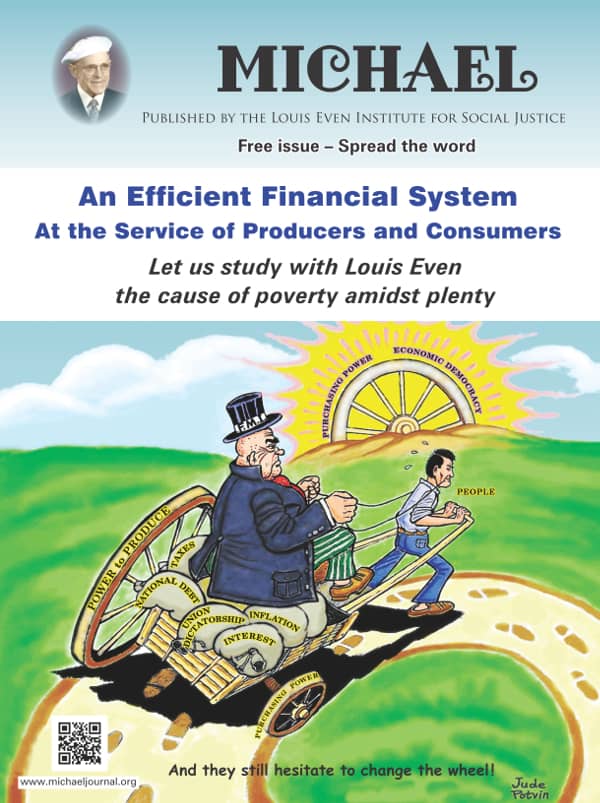 An Efficient Financial System, written by Louis Even, is for the reader who has some understanding of the Douglas Social Credit monetary reform principles. Technical aspects and applications are discussed in short chapters dedicated to the three propositions, how equilibrium between prices and purchasing power can be achieved, the financing of private and public production, how a Social Dividend would be financed, and, finally, what would become of taxes under a Douglas Social Credit economy. Study this publication to better grasp the practical application of Douglas' work.
 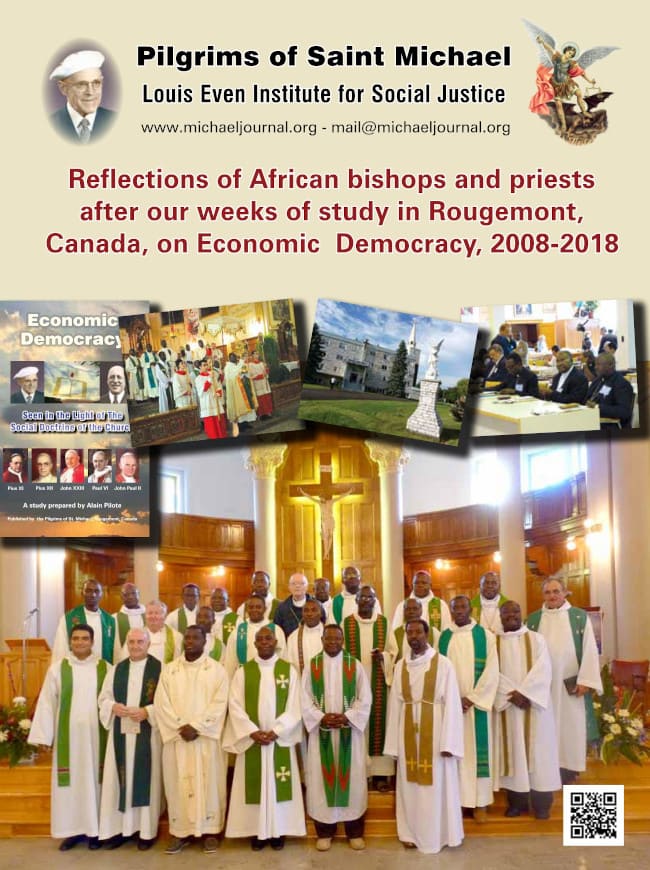 Reflections of African bishops and priests after our weeks of study in Rougemont, Canada, on Economic Democracy, 2008-2018
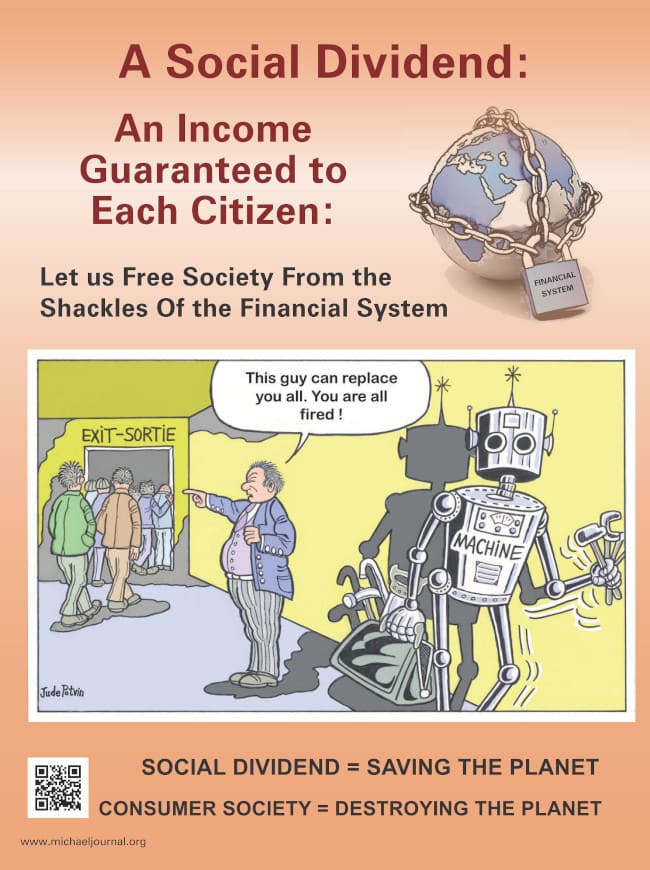 The Social Dividend is one of three principles that comprise the Social Credit monetary reform which is the topic of this booklet. The Social Dividend is an income granted to each citizen from cradle to grave, with- out condition, regardless of employment status.
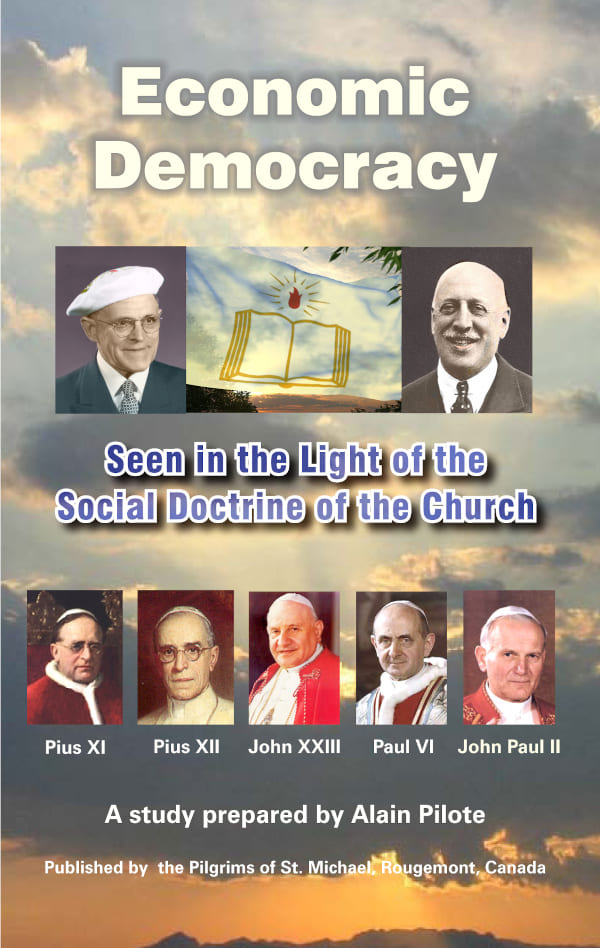 Economic Democracy is a book to explain Social Credit in lessons presented in logical order so it may be easier to the reader to grab the main principles of Social Credit rapidly and somehow easily.
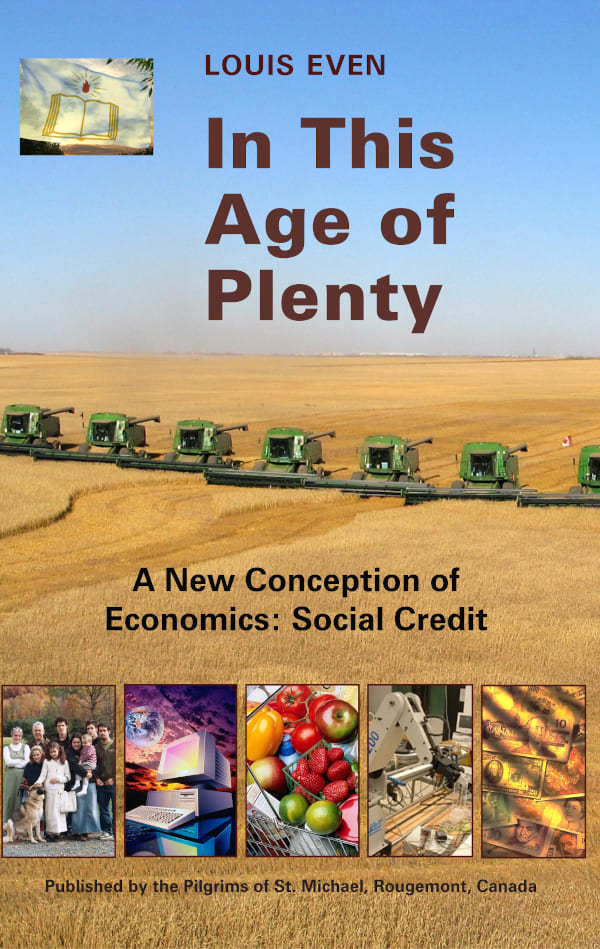 In This Age of Plenty deals with Social Credit, but it does not exhaust the topic. Social Credit principles address social and political matters, as well as, or even more so, than economics and will put civilization on a new course.
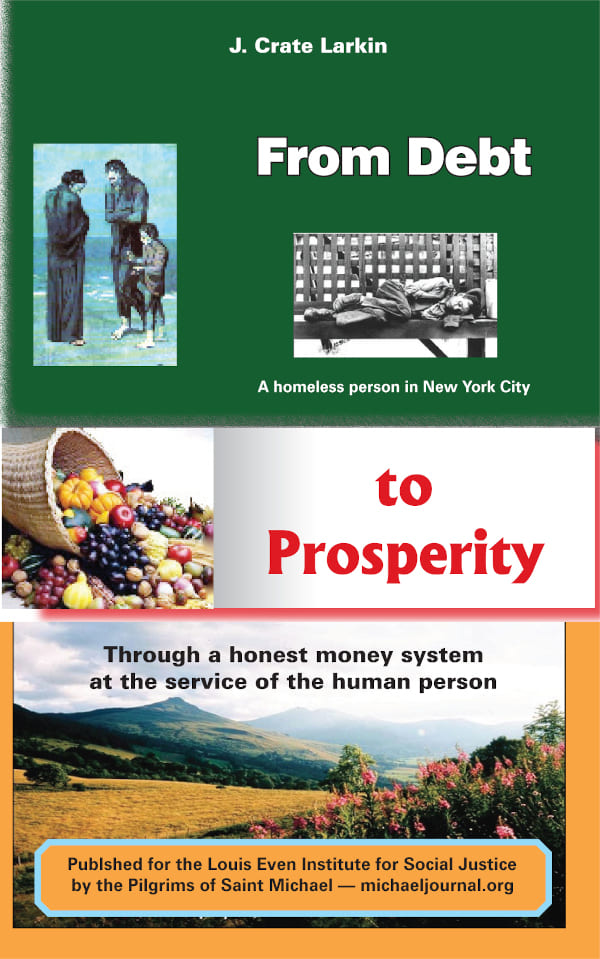 From Debt to Prosperity outlines briefly the economic analysis and constructive proposals known as Social Credit.
 Subscribe