

The list of towns and cities which have adopted the Union of Electors'resolution a pro- pos of interest free loans, is growing steadily.
The resolution asks the federal government to take the necessary steps to the end that the Bank of Canada will advance credits, without interest charges, to finance developments projected by municipalities, school commissions and other public bodies. The resolution also asks the provincial governments to press the federal government for the adoption of this resolution.
Following is a partial list of those municipalities which have already adopted the resolution.
Montreal-North
Pointe-aux-Trembles
Ville Jacques-Cartier
Quebec-West
Drummondville
Sherbrooke
Asbestos
Granby
Thetford Mines
Black Lake
Lake Megantic
Shawinigan Sorel
Magog
Grand'Mere
Victoriaville
Hull
Gatineau Point
Malartic
Rouyn
East Amos
Chicoutimi
Arvida
Jonquiere
Kenogami
Bagotville
Dolbeau
Alma
Bromptonville
Woburn
Tring Junction
St. Leandre
Fugereville
Ville-Marie
Bryson
Cheneville
La Dorée
St. Clotilde
South Shawinigan
St. Joseph de Sorel
Levis
Roberval
Omerville
St. Aubert
Hawkesbury
St. François de Sales
Lac des Plages
Loverlochere
Soloman
Naudville
Maniwaki
Varennes
St. Stanislas
St. Martin
St. Bruno
Arvida
Metabetchouan village
Ville St. Michel
These are a few of the multitude of communities which are reaching the breaking point under the load of taxation necessitated by our illogical and unrealistic financial system. Taxes can scarcely be increased any more; they are already scraping the bottom of the citizens' wallets. The provincial and federal governments can bring little aid since they too are facing their own excruciating financial problems and can get more money only by more and more borrowing. Which means more and more future taxes on the population to meet the growing mountain of interest charges.
And the tragic side of this story is that there is no physical obstacle preventing any community or agglomeration of communities realizing the projects and works made necessary by the needs of the people. The material is there in abundance; the willing and strong arms are there, as is witnessed by our unemployment figures at any time of the year; the genius and talent is there as is proved by the fantastic projects already realized by the people of our country.
And the needs are there - the need for new roads and highways and the renovation of the old, the need for aqueducts, sewage disposal plants, schools, hospitals, public buildings, parks playgrounds for our children, etc., etc. Yes, the needs are there and the material and labor to meet these needs are there, both in abundance.
Then what prevents a conjunction of these two, needs and the means to satisfy these needs? Nothing natural or divine. One thing and one thing only. A man-made obstacle; our financial system.
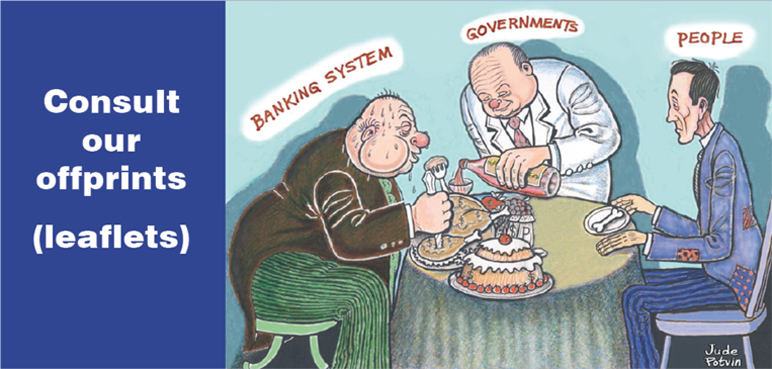
When our citizens want to carry out a public work they must pay out to the financiers money which has not been put into circulation by the creators of money who are these same financiers. For that is what interest is. When a municipality borrows in order to build a bridge or construct an aqueduct, it must borrow from the financiers the actual cost of the work, and then, later on, borrow the money with which to pay the interest charges on the first loan. As you can see, this system of financing is admirably designed to keep the people everlastingly in debt to the small and powerful group of men who run the financial system of the country as their own private business, dealing in money as a commodity which they rent to the people. And the laws of our country make it legal for them to do so.
However, as the list of municipalities above shows, more and more towns and cities are beginning to realize that the only solution to this intolerable situation is to make the bank of the people, the Bank of Canada, do that which it was set up for aid the people to realize a life of decent comfort without that sword of Damocles, fear for tomorrow's food, clothing and lodging, hanging over their heads. And how can the Bank help to do this?
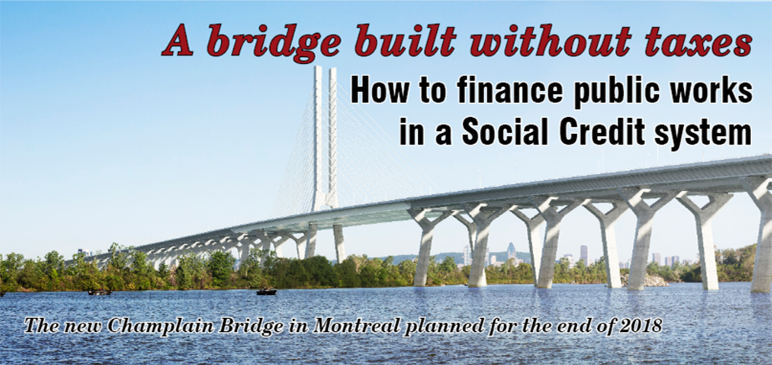
By issuing credits, free of interest charges, for the financing of all public works by public corporations. For all such works are works of the people as a whole, not of private individuals only; they are realized, physically by the material which the people together produce through the labor and ingenuity of the people, again, together. Hence there is no logical reason why they should be penalized by having to pay private individuals vast sums for the right to have something which they the people themselves, and they alone, not the financiers, produce.
That is why more and more municipalities are joining those who have already passed and ac- cepted the proposal of the Union of Electors; that the Bank of Canada issue interest free credits for the financing of all projects devised by municipalities and school commissions.
E. M.
Political democracy without economic democracy is dynamite.
(The Monopoly of Credit, p. 120).
Study Session on Economic Democracy And Annual Congress
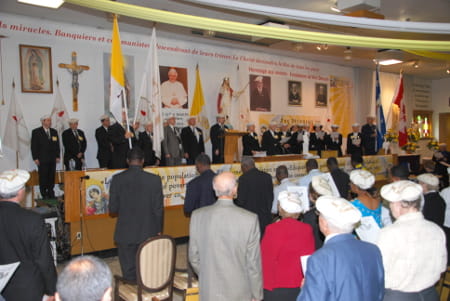
Discover C.H. Douglas’s proposals for economic and social renewal with the Pilgrims of St. Michael in Rougemont, Quebec Canada from Sept. 23 through September 28 2026.
Rougemont Quebec Monthly Meetings
Every 4th Sunday of every month, a monthly meeting is held in Rougemont.
 In this special issue of the journal, MICHAEL, the reader will discover who are the true rulers of the world. We discuss that the current monetary system is a mechanism to control populations. The reader will come to understand that "crises" are created and that when governments attempt to get out of the grip of financial tyranny wars are waged.
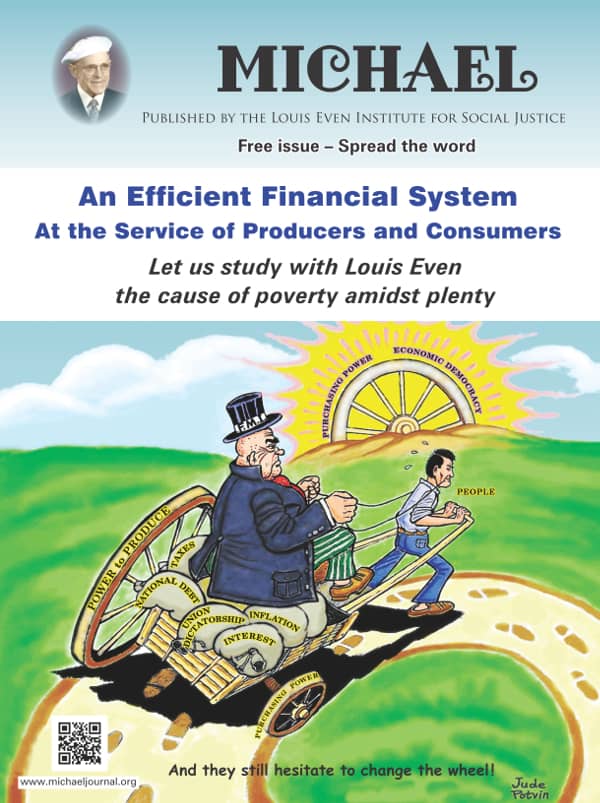 An Efficient Financial System, written by Louis Even, is for the reader who has some understanding of the Douglas Social Credit monetary reform principles. Technical aspects and applications are discussed in short chapters dedicated to the three propositions, how equilibrium between prices and purchasing power can be achieved, the financing of private and public production, how a Social Dividend would be financed, and, finally, what would become of taxes under a Douglas Social Credit economy. Study this publication to better grasp the practical application of Douglas' work.
 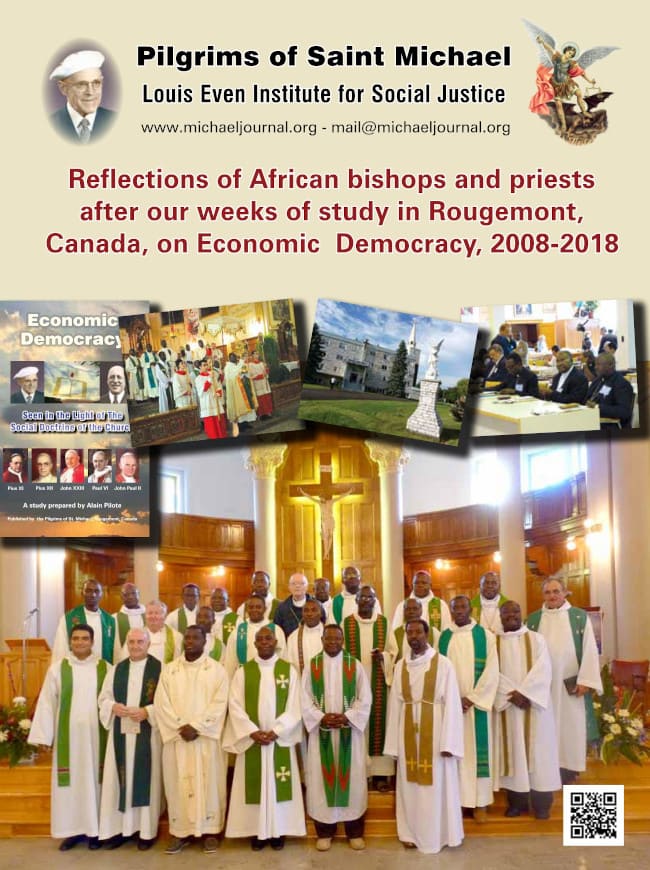 Reflections of African bishops and priests after our weeks of study in Rougemont, Canada, on Economic Democracy, 2008-2018
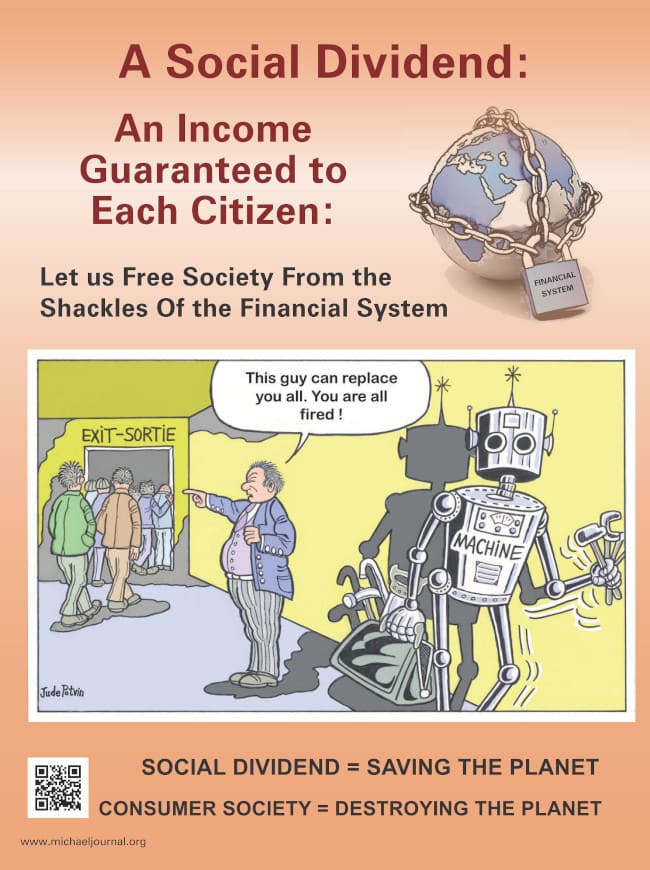 The Social Dividend is one of three principles that comprise the Social Credit monetary reform which is the topic of this booklet. The Social Dividend is an income granted to each citizen from cradle to grave, with- out condition, regardless of employment status.
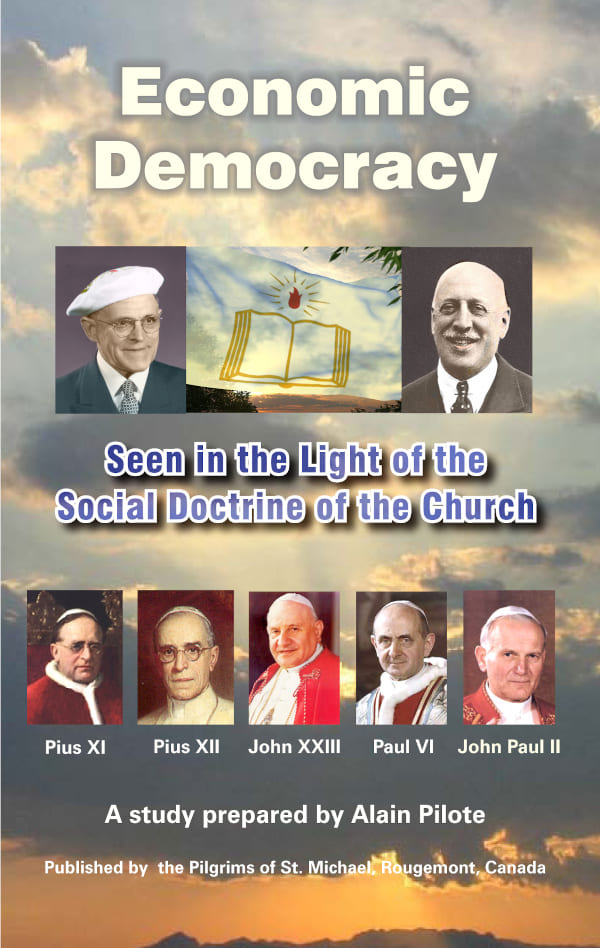 Economic Democracy is a book to explain Social Credit in lessons presented in logical order so it may be easier to the reader to grab the main principles of Social Credit rapidly and somehow easily.
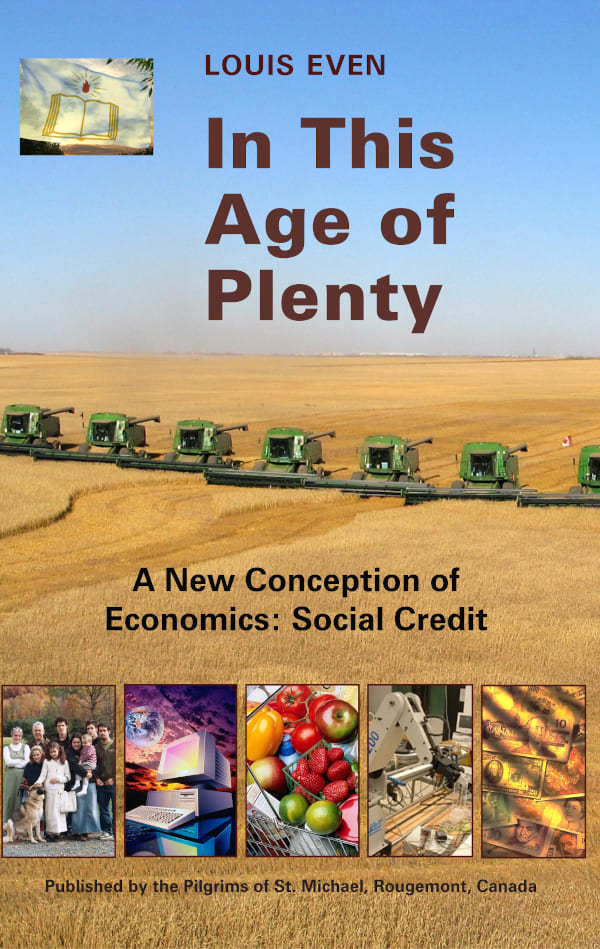 In This Age of Plenty deals with Social Credit, but it does not exhaust the topic. Social Credit principles address social and political matters, as well as, or even more so, than economics and will put civilization on a new course.
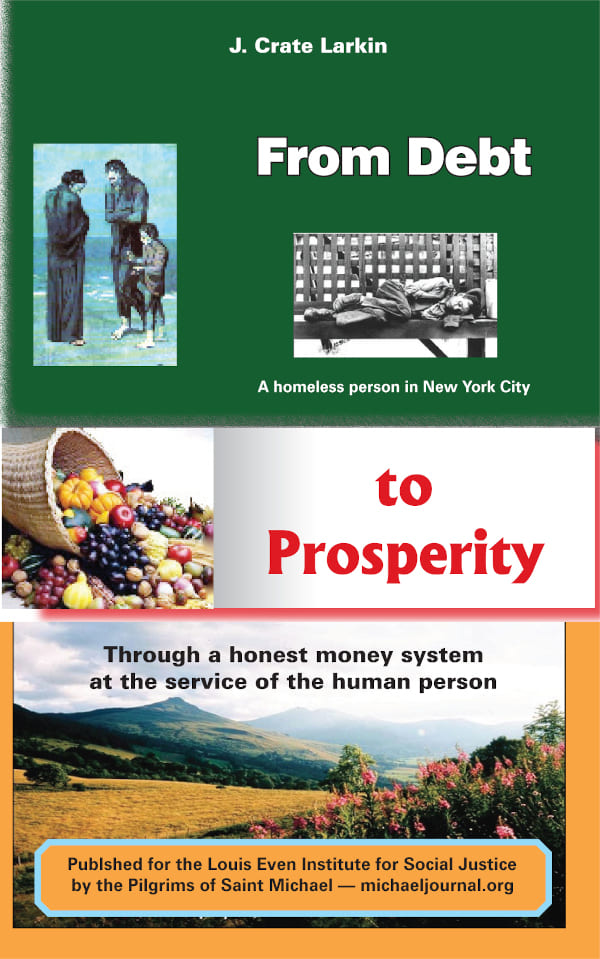 From Debt to Prosperity outlines briefly the economic analysis and constructive proposals known as Social Credit.
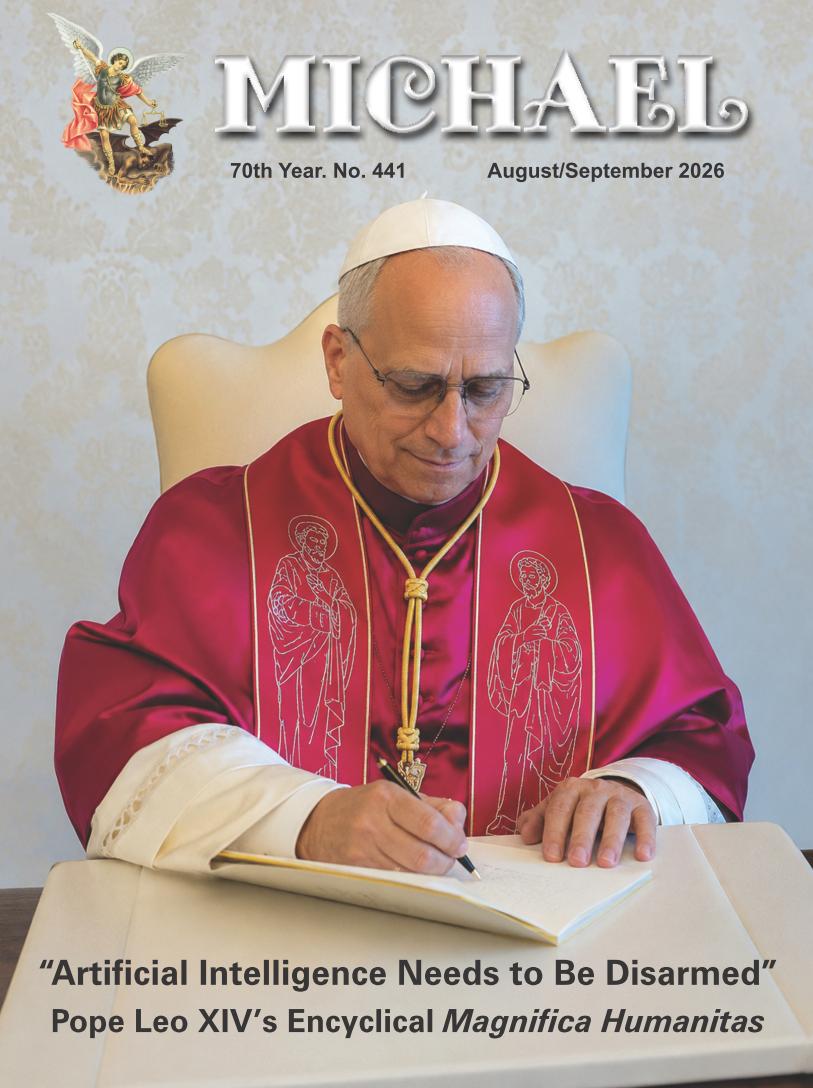 Subscribe