

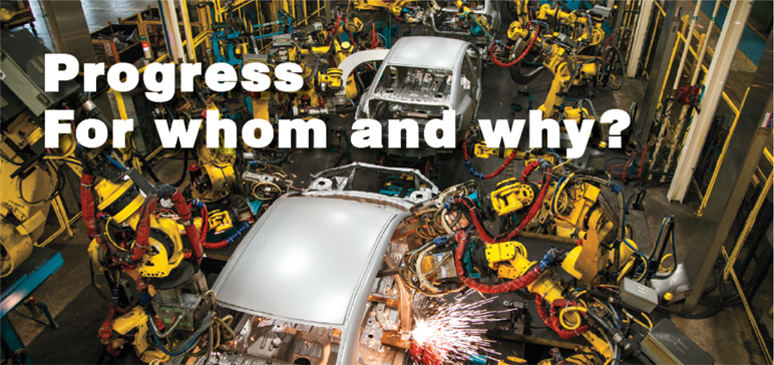
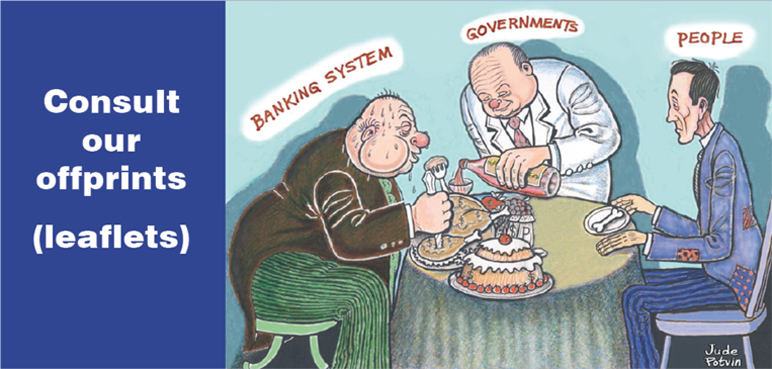

In its issue of January 30, 1962, The Times published a report from its Washington Correspondent on a study of the effect of computers and automation undertaken by the Centre for the Study of Democratic Institutions. Mr. Donald Mitchell at the Centre's request, has recorded the findings in Cybernation: The Silent Conquest. The word Cybernation is derived from Cybernetics, relating to process of communication and control in men and machines.
The Times correspondent says that the study concludes that the widespread use of computers and automation "may create vast unemployment and social unrest, which could seriously weaken the foundations: of free society and lead to new Luddite wars. (Riots provoked in England between 1811 and 1816, for the purpose of preventing the introduction of labour-saving machinery into industry. - Ed. T.U.E.) The danger that Government may become 'computerized', and its policies and decisions more difficult for the public to understand, is also foreseen."
The correspondent's message is illuminating concerning the state of awareness in the U.S.A. While cybernation is regarded as inevitable, it is foreseen that unemployment will be widespread among the managerial class, the service industries and the manufacturing industries. It may also occur widely among untrained adolescents, with almost inevitable delinquency, contributing to further social disruption.
The correspondent says, "No one has seriously proposed what the unemployed in the service industries can be retained to do, to say nothing of training them for jobs that would pay them high enough wages to make them good consumers of the cornucopia of products manufactured by automation. Shorter hours will clearly not solve the problem when the task is eliminated or new tasks need different talents." Talking of a "solution", while public works programmes are regarded as an obvious solution, the reporter believes that they would not be conducive to maintaining the spirit of a capitalistic economy.
"Leisure will also be a problem. Boredom might lead many to take part in radical organizations, while family adjustments for those working thirty-two or fewer hours a week will be added to already inadequate, ambiguous and frustrating personal relationship that typify much of the middle-class family life."
The government's increasing use of computers, it is said, will inevitably lead the public ignorance of major issues. · "The idea of the individual may be completely swallowed up in statistics. The planner and those he plans for may become divorced.".
The correspondent states that the report includes a section on the possible control of cybernation - "a moratorium is ruled out, and it is suggested that a new set of goals and methods for the country's educational system could be developed. If we do not find the answers soon we will have a population in the next ten or twenty years more and more out of touch - with national and international realities, ever more the victims of insecurity on the one hand and ennui on the other."
The report continues; "If the new standards are inadequate, frustration may evoke a war of desperation ostensibly against some external enemy, but in fact to make the world safe for human beings by destroying most of society's technological face." To readers of The Social Crediter and of C. H. Douglas's works, the subject matter of the above report will be familiar - "Unemployment", "Leisure", "Automation", "Educational "System". Douglas penetrated to the very root of such matters and placed them in their proper perspective - as, for example, in The Tragedy of Human Effort.
The Social Crediter for March 31, 1962,
Readers of the Union of Electors will also perceive in the above report some of the reasons why our movement has been advocating the universal dividend. It will also be apparent to them that there is a very urgent need for not only such a form of the monetary system as will give security with independence to the individual, but also for the education of the individual so that he may be in a position to make the greatest possible use of his natural faculties and talents when our economic system grants him more and more leisure time.
E. M.
- Mrs. Adrien Demers of Rimouski, wrote to our offices as follows: "Saturday night, on television, we had the chief of the turncoats, Réal Caouette, who said that the White Berets (the members of our movement wear white berets) were working in the moon, (travaillent dans la lune). Mrs. Boudreau and I tried to reach him by phone, believing him to be in Rimouski. We wanted to ask him what particular planet he was working on, because on this earth we have certainly not seen any beneficial results from his work - especially among the poor." - Mrs. Demers speaks with considerable truth. A tree is known by its fruits. The fruits of the work of the "bérets blancs" are many and may be seen by all -- not on the moon, but right here on earth. - There are thousands of individuals who will give testimony to this. But where are we to find any evidence of good work accomplished by Caouette and the others who followed him out of the movement?
Pressure is still being applied to the Hon. "John Diefenbaker to have family allowance rates increased to $15 a month for each child. The Crediters of the Union of Electors are hard at work sending telegrams, having petitions signed and urging their local public organizations to get behind the demand. Following is a list of fairly important public bodies which have adopted resolutions in favour of the demand.
Sherbrooke: Promoter – Ronald Gendron, Crediter.
Victoriaville: Proposed by municipal councillor, Pepin and seconded by councillor Saint-Pierre. Promoter — Jean-Paul Bellemare, Crediter.
Sorel: Unanimously adopted.
Magog-Canton: Proposed by Councillor Philippe Robert, seconded by councillor Leo Dostie and adopted unanimously. Promoter - Edwidge Laplante, Crediter.
Kingsley Falls, Richmond: Proposed by councillor Wilfrid Elie and seconded by councillor Emery Rivard. Promoter — Adolphe Proulx.
St-Adrien-de-Ham, Wolfe: Promoted by Marcel Lavallée, Crediter.
St-Stanislas, Roberval: Proposed by councillor Philippe Laprise and seconded by councillor Eugène Imbault.
Val-Brillant, Matapedia: Adopted unanimously. Promoted by Arthur Bouchard, Crediter.
Sainte-Marguerite, Matapedia: Proposed by councillor Edmond Carriere and seconded by councillor Patrick Rioux. Promoted by Arthur Bouchard, Crediter.
Ste-Clotilde, Arthabaska: Proposed by councillor George Biron and adopted unanimously.
Ste-Anne-de-Beaupré, Village: Proposed by councillor Armand Bilodeau and seconded by councillor Jos. Rousseau. Promoted by Henri-Paul Tremblay, Crediter.
Mont-Joli, Matane: Proposed by councillor Emile St-Onge and seconded-by councillor Maurice Fournier and adopted unanimously. Promoted by Jean-Charles Dionne, Crediter.
Luceville, Rimouski: Proposed by councillor André Desrosiers and seconded by councillor Napoléon Pelletier. Promoted by Luc Lemieux, Crediter.
Our heartiest congratulations to all who are taking part in this work of applying pressure to the country's government for the passage of a very necessary bit of legislation.
Particular merit to those men who have worked so actively to bring public bodies behind this measure. Such work is completely in line with the doctrine of Social Credit and was taught by Major Douglas who suggested that influence on government should begin at the lower levels.
Aren't the people warned of the following dangers?
Fluorides destroy vitamins, enzymes and proteins. Fluorides accumulate over the years. — can reach toxic levels. Fluorides prevent calcium from depositing in bones causing softening of the bones (osteoporosis). Fluorides are potentially toxic to every organ of the body.
Citizens Rights Association, Toronto
"Socialism merely consists in the gospel of grab - grab your neighbour's initiative, grab his opportunities, grab his ideas, and eventually grab his identity. The only new thing about it is its name".
MAJOR DOUGLAS
Study Session on Economic Democracy And Annual Congress
Discover C.H. Douglas’s proposals for economic and social renewal with the Pilgrims of St. Michael in Rougemont, Quebec Canada from Sept. 23 through September 28 2026.

Rougemont Quebec Monthly Meetings
Every 4th Sunday of every month, a monthly meeting is held in Rougemont.
 In this special issue of the journal, MICHAEL, the reader will discover who are the true rulers of the world. We discuss that the current monetary system is a mechanism to control populations. The reader will come to understand that "crises" are created and that when governments attempt to get out of the grip of financial tyranny wars are waged.
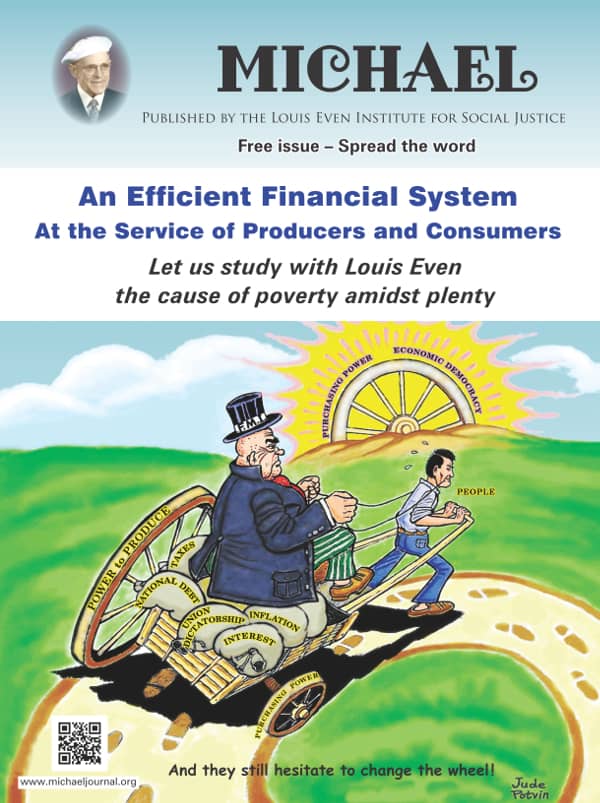 An Efficient Financial System, written by Louis Even, is for the reader who has some understanding of the Douglas Social Credit monetary reform principles. Technical aspects and applications are discussed in short chapters dedicated to the three propositions, how equilibrium between prices and purchasing power can be achieved, the financing of private and public production, how a Social Dividend would be financed, and, finally, what would become of taxes under a Douglas Social Credit economy. Study this publication to better grasp the practical application of Douglas' work.
  Reflections of African bishops and priests after our weeks of study in Rougemont, Canada, on Economic Democracy, 2008-2018
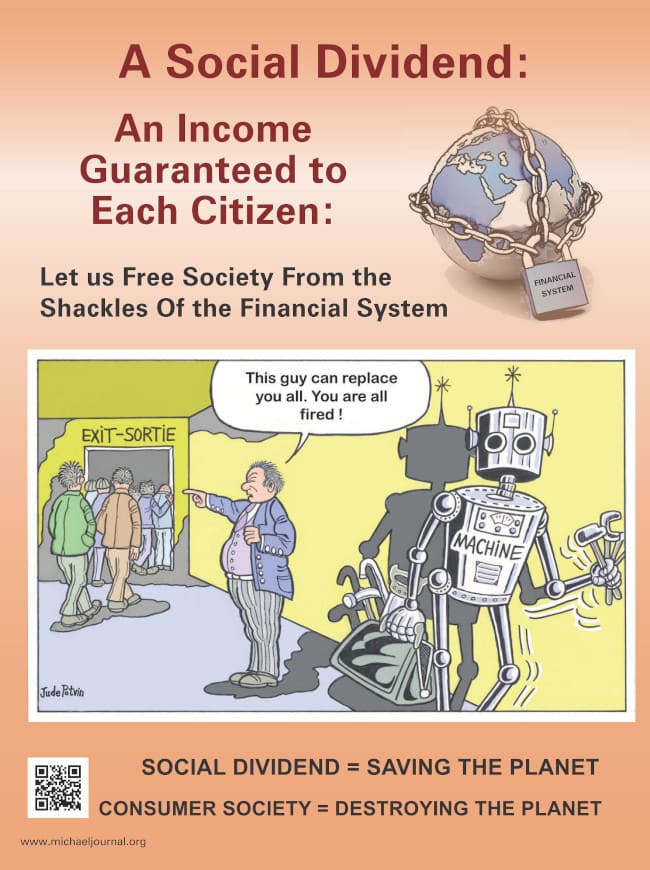 The Social Dividend is one of three principles that comprise the Social Credit monetary reform which is the topic of this booklet. The Social Dividend is an income granted to each citizen from cradle to grave, with- out condition, regardless of employment status.
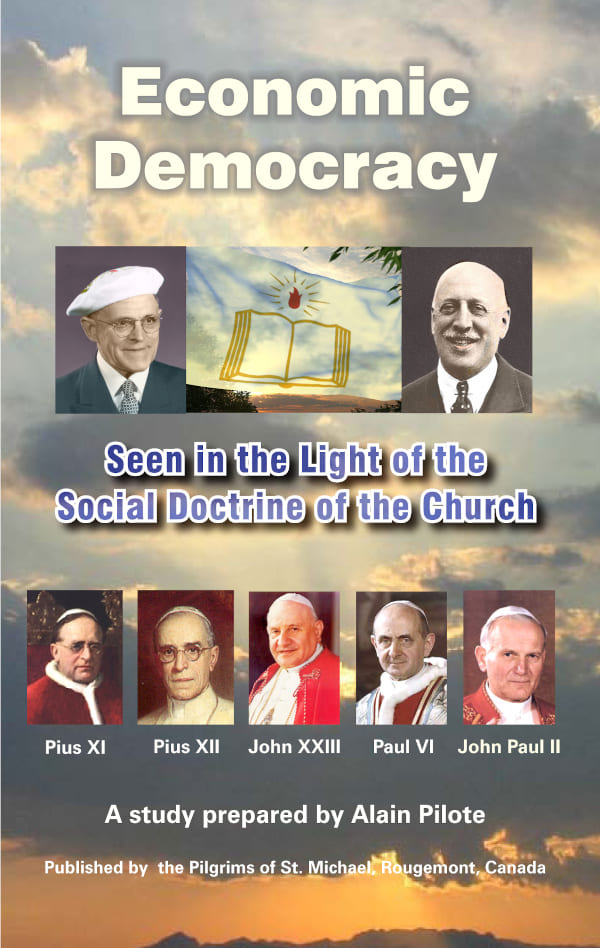 Economic Democracy is a book to explain Social Credit in lessons presented in logical order so it may be easier to the reader to grab the main principles of Social Credit rapidly and somehow easily.
 In This Age of Plenty deals with Social Credit, but it does not exhaust the topic. Social Credit principles address social and political matters, as well as, or even more so, than economics and will put civilization on a new course.
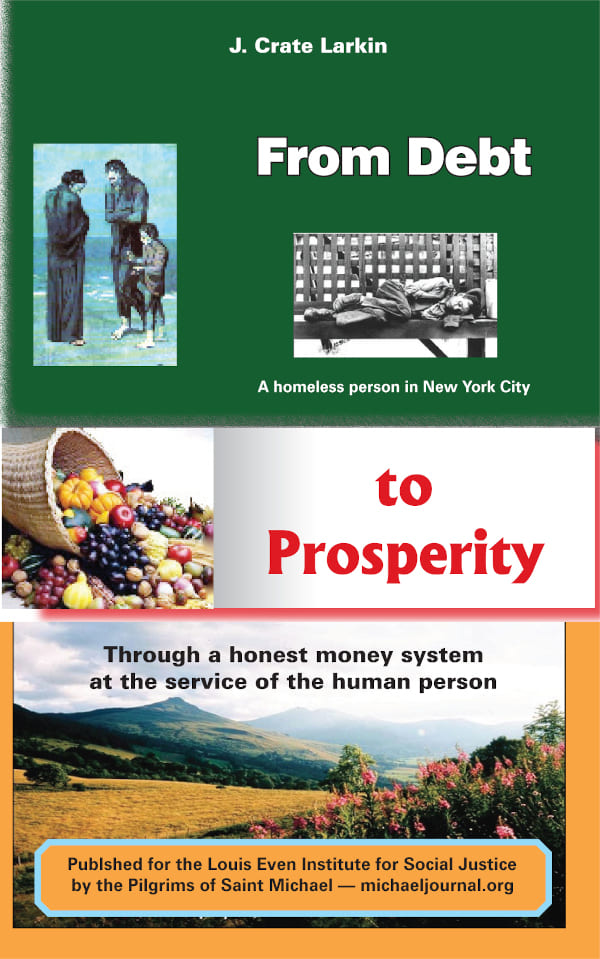 From Debt to Prosperity outlines briefly the economic analysis and constructive proposals known as Social Credit.
 Subscribe