






Réal Latulippe, a member of our movement, had reprinted in "La Revue de Granby" (a Quebec paper) the following arguments against fluoridation. These arguments have appeared at one time or another in Vers Demain or The Union of Electors. They bear repeating in the face of the obstinate propaganda of the fluoridators.
Whether or not the fluoridation of water is good for growing teeth is not the point at issue. The point to be argued is whether or not people are to be free to take it if they want, or not to take it if they do not wish to.
The water supply does not take into consideration this liberty. The pharmacist respects it. Consequently those who are all for taking sodium fluoride should go to the pharmacist and not to the municipal water supply. The term, "water supply", means exactly what it says; not a "means for the transmission of medicaments":
Even if the proportion of sodium fluoride thrown into the water is carefully and scientific calculated; even if, by some means or other, this carefully calculated proportion can be brought into the thousands of taps used by the people, through the miles and miles of water piping making up the water supply system; even if all this can be done, how can we guarantee that each child will receive the exact and safe dosage when one child will drink one or two glasses, of water a day, whereas another might drink twice that number?
And even admitting, for the sake of hypothesis, that this fluoridated water is good for the teeth, what guarantee have we that it will not have a deleterious effect on some other organs or parts of the body?
Do the molecules of sodium fluoride move through the body under the guidance of some electronic brain posted in the central office of the water supply department?
If we are going to have mass medication for the teeth, then why not undertake such collective treatment for other parts of the human body? Man is made up of more than teeth. He is subject to other ills besides tooth decay.
- But, some will say, everyone is agreed upon the treatment of water with chlorine; why not, then, its treatment with fluoride?
- The two are quite different things. Chlorine is put in the water to make it fit to drink. This is a function rightly appertaining to the municipality and its government. It is a civic act. On the other hand, sodium fluoride is put in the water, not to treat the water but to treat the teeth of growing children. This is a function which pertains to medicine, to the society of doctors.
Chlorine has for its function to cleanse the water from harmful bacteria, to rid it of those elements which could cause epidemics. But what harmful matter is sodium fluoride supposed to banish from the water?
Those in charge of purifying the water certainly have as their function the mixing of chlorine with the water (until some better means is found) so that the people may have pure water to drink. But the treatment of tooth decay, or any other human ailment, pertains to medicine, and can by no means be considered as falling within the jurisdiction of municipal authorities such as the water works employees.
Study Session on Economic Democracy And Annual Congress
Discover C.H. Douglas’s proposals for economic and social renewal with the Pilgrims of St. Michael in Rougemont, Quebec Canada from Sept. 23 through September 28 2026.

Rougemont Quebec Monthly Meetings
Every 4th Sunday of every month, a monthly meeting is held in Rougemont.
 In this special issue of the journal, MICHAEL, the reader will discover who are the true rulers of the world. We discuss that the current monetary system is a mechanism to control populations. The reader will come to understand that "crises" are created and that when governments attempt to get out of the grip of financial tyranny wars are waged.
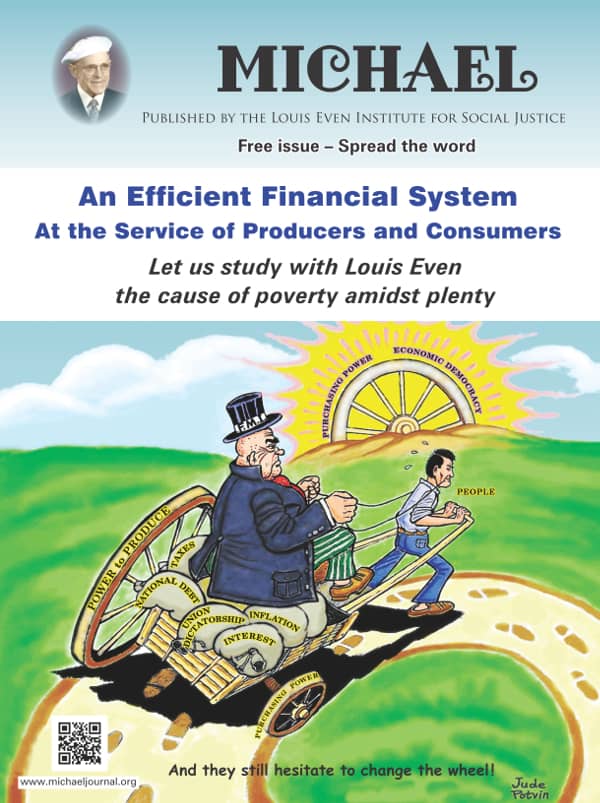 An Efficient Financial System, written by Louis Even, is for the reader who has some understanding of the Douglas Social Credit monetary reform principles. Technical aspects and applications are discussed in short chapters dedicated to the three propositions, how equilibrium between prices and purchasing power can be achieved, the financing of private and public production, how a Social Dividend would be financed, and, finally, what would become of taxes under a Douglas Social Credit economy. Study this publication to better grasp the practical application of Douglas' work.
  Reflections of African bishops and priests after our weeks of study in Rougemont, Canada, on Economic Democracy, 2008-2018
 The Social Dividend is one of three principles that comprise the Social Credit monetary reform which is the topic of this booklet. The Social Dividend is an income granted to each citizen from cradle to grave, with- out condition, regardless of employment status.
 Economic Democracy is a book to explain Social Credit in lessons presented in logical order so it may be easier to the reader to grab the main principles of Social Credit rapidly and somehow easily.
 In This Age of Plenty deals with Social Credit, but it does not exhaust the topic. Social Credit principles address social and political matters, as well as, or even more so, than economics and will put civilization on a new course.
 From Debt to Prosperity outlines briefly the economic analysis and constructive proposals known as Social Credit.
 Subscribe