|
The Seven Sorrows
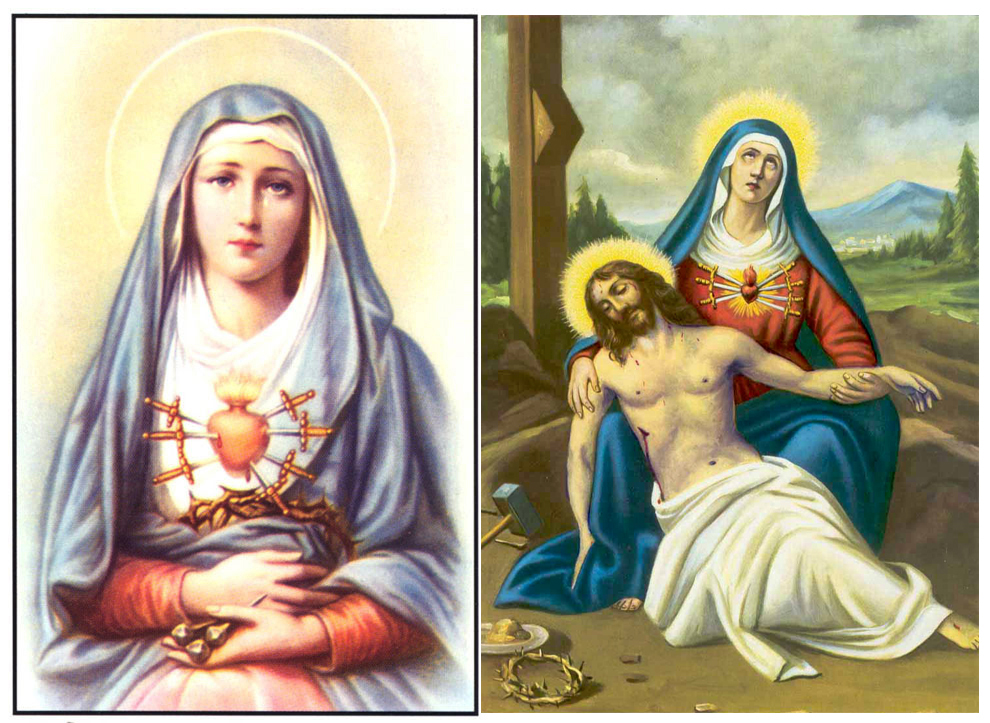
of Mary The Blessed Virgen Mary grants seven graces to the souls who honor her daily by meditating on her tears and dolors (sorrows). The "Hail Mary..." is prayed seven times, after each meditation.
La Bienheureuse Vierge Marie donne sept grâces aux âmes qui l'honore chaque jour en méditant sur ses larmes et douleurs. On doit dire le "Je vous salue Marie..." sept fois, après chaque méditation.
Here are the Seven Graces – Voici les Sept Grâces
1. I will grant peace to their families. Je donnerai paix à leur famille.
2. They will be enlightened about the divine mysteries. Ils seront éclairés sur les divins mystères.
3. I will console them in their pains and I will accompany them in their work. Je les consolerai dans leurs peines et je les accompagnerai dans leur travail.
4. I will give them as much as they ask for as long as it does not oppose the adorable will of my divine Son or the sanctification of their souls. Je leur donnerai autant qu'ils demanderont pourvu que cela ne s'oppose pas à la volonté adorable de mon divin Fils ni à la sanctification de leur âme.
5. I will defend them in their spiritual battles with the infernal enemy and I will protect them at every instant of their lives. Je les défenderai dans leurs batailles spirituelles avec l'ennemi infernal et je les protègerai à chaque instant de leur vie.
6. I will visibly help them at the moment of their death, they will see the face of their Mother. Je les aiderai visiblement au moment de leur mort, ils verront le visage de leur Mère.
7. I have obtained (This Grace) from my divine Son, that those who propagate this devotion to my tears and dolors will be taken directly from this earthy life to eternal happiness since all of their sins will be forgiven and my Son and I will be their eternal consolation and joy. J'ai obtenu (Cette Grâce) de mon divin Fils, que ceux qui propagent cette dévotion à mes larmes et douleurs passeront directement de cette vie terrestre au bonheur éternel car tous leurs péchés seront pardonnés et mon Fils et moi-même seront leur consolation et leur joie éternelle.
The
Seven Sorrows -
Les Sept Douleurs 1. The prophecy of Simeon (St.Luke II, 34, 35) 1. La prophétie de Siméon (St-Luc II, 34, 35)
The Most Blessed Virgin Mary, having introduced her Only son to the
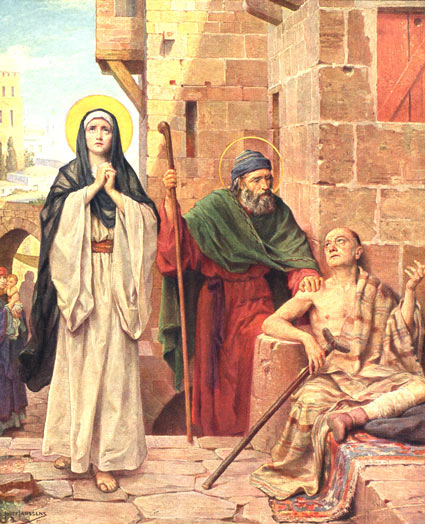
Temple, the saint Simeon old man says to her: "This Child will be in butts
with contradiction, and yourself, a sword will transpierce your heart."
By these words, he announced the Passion and the Death of Jesus-Christ Our
Lord to her.
La Très Sainte Vierge Marie ayant présenté son Fils unique au Temple, le
saint vieillard Siméon lui dit: "Cet Enfant sera en bute à la
contradiction, et toi-même, un glaive transpercera ton âme." Par ces
paroles, il lui annonça la Passion et la Mort de Jésus-Christ Notre-Seigneur.
2. The flight into Egypt (St.Matthew II, 13-14) 2. La fuite en Égypte (St-mattieu II, 13-14)
The Most Blessed Virgin Mary is obliged to flee in Egypt to withdraw Jesus
child from the persecution of the cruel Herod, which seeks Him to put Him
at death.
La Très Sainte Vierge Marie est obligée de fuir en Égypte pour soustraire
l'Enfant Jésus à la persécution du cruel Hérode, qui le cherche pour le
mettre à mort.
3. The loss of the Child Jesus in the Temple (St.Luke II, 43-45) 3. La perte de l'Enfant Jésus dans le Temple (St-Luc II, 43-45)
The Most Blessed Virgin Mary, with the return of the Easter, does not find any more Jesus child, and during three whole days seeks Him with saint Joseph in the greatest affliction (sorrow).
The happy group of pilgrims were returning from Jerusalem. They had come a day's journey when another sorrow came to Mary. Jesus was not in the group. Joseph and Mary went from neighbour to acquaintance to stranger asking if they had seen Him, but from each came the same answer, no. The pilgrimage moved on and the anxious parents retraced their weary steps to Jerusalem. Am I as anxious? Do I with sorrow in my heart, seek Jesus if He is lost to me because of sin? 1 Pater, 7 Ave
La Très Sainte Vierge Marie, au retour des fêtes de Pâques, ne trouve plus l'Enfant Jésus, et pendant trois jours entiers le cherche avec saint Joseph dans la plus grande affliction.
L'heureux groupe de pèlerins revenaient de Jérusalem. Ils avaient fait un jour de voyage quand une autre douleur est venu à Marie. Jésus n'était pas dans le groupe. Joseph et Marie sont allés, de voisin à étranger, demander s'ils l'avaient vu, mais tous ont la même réponse, non. Le pèlerinage a continué et les parents inquiets sont revenus sur leurs pas à Jérusalem. Suis-je aussi anxieux? Est-ce avec douleur dans mon cœur, que je cherche Jésus s'il est perdu pour moi à cause du péché? 1 Pater, 7 Ave
4. The meeting of Jesus and Mary on the Way of the Cross 4. La rencontre de Jésus et Marie sur le Chemin de la Croix
The Most Blessed Virgin Mary meet Jesus on the way of the Calvary
(Martyrdom), and see Him bearing on His wounded shoulders the heavy cross
to which He will be attached for our salvation.
La Très Sainte Vierge Marie rencontre Jésus sur le chemin du Calvaire, et le voit portant sur ses épaules déchirées la lourde croix à laquelle il va être attaché pour notre salut.
Le coup le plus dur jusqu'à présent dans ses nombreuses peines arrive à
Marie. Son Fils, son enfant, est maintenant entre les mains de ses ennemis.
Il est meurtri et saigne. Il est couronné d'épines. Il porte une lourde
croix et les méchants sont déterminés à le mettre à mort. Si les hommes
sympatisent avec la mère qui regarde son fils endurer de grandes
souffrances, sans être en mesure de l'aider, combien grande doit être
notre pitié quand nous nous rendons compte que nous sommes la cause de la
souffrance du Fils, et de la douleur de cette Mère. 1 Pater, 7 Ave 5. The Crucifixion
5. Le
Crucifiement
The Most Blessed Virgin Mary sees Jesus nailed to the cross, spreading His
blood by all the wounds whose His body is covered and dying finally after
three hours of cruel torments.
Les clous cruels ont creusé des trous profonds dans ses mains et ses pieds. La croix, élevée haute et Son corps tourmenté par la douleur et les affaissements, font que les blessures des mains et des pieds s'ouvrent davantage. Marie se tient en regardant la croix jusqu'à ce qu'elle sache que Son Fils ne vit plus, mais qu'Il a remit son Esprit à son Père Éternel. 1 Pater, 7 Ave
6. The taking down of the Body of Jesus from the Cross 6. La descente du Corps de Jésus de la Croix
The Most Blessed Virgin Mary, after having seen the Heart of her divine Son transpierced of the sword, receives his inanimate body on her knees.
Consider the most bitter sorrow which pierced the soul of Mary as she held the death body of Jesus in her arms. The flesh torn with deep wounds is covered with blood. John, Mary Magdalen, and Nicodemus, her companions who stayed with her to confort and console, were of little assistance for they too were prostrate with grief. 1 Pater, 7 Ave
La Très Sainte Vierge Marie, après avoir vu le Coeur de son divin Fils percé de la lance, reçoit son corps inanimé sur ses genoux.
Considére la douleur la plus amère qui transperça l'âme de Marie
lorsqu'elle tenait le corps sans vie de Jésus dans ses bras. La chair
déchirée, avec des blessures profondes, est couverte de sang. Jean,
Marie-Madeleine, et Nicodème, ses compagnons qui sont restés avec elle
pour la réconforter et la consoler, ne sont guère utiles car eux aussi
sont accablés de douleur. 1 Pater, 7 Ave 7. The burial of Jesus 7. L'ensevelissement de Jésus et le retour du sépulcre
The Most Blessed Virgin Mary accompanies to the tomb the very holy body of her Son, and sees the heavy rolled stone at the entry of the sepulchre.
Our grief over the death of a loved one is more acute at the moment when the casket is lowered in the grave than at any other time. For now, death seems so final, the separation so complete. What then, was the sorrow of Mary as she gazed for the last time at the lifeless body of Her Son as the great stone was rolled forward to seal the door of the sepulchre? 1 Pater, 7 Ave
La Très Sainte Vierge Marie accompagne au tombeau le corps très saint de son Fils, et voit la lourde pierre roulée à l'entrée du sépulcre. 1 Pater, 7 Ave
Notre douleur sur la mort d'un être cher est plus grande au moment où le cercueil descend dans la tombe qu'à tout autre moment. Pour l'instant, la mort semble si définitive, la séparation si complète. Quel était donc la douleur de Marie quand elle le regardait pour la dernière fois le corps sans vie de son Fils lorsque la grande pierre avait été roulée pour sceller la porte du sépulcre? 1 Pater, 7 Ave
*******************************
(We can recite this prayer nine times, to obtain a special grace.)
O Mary most desolate of all mothers; what a terrible sword has penetrated your soul! All shots attacking Jesus have fallen on you; all his pain shot you; all his wounds have torn you; but especially the last farewell he addressed to you opened all your wounds; and when you saw him make his last breath, what supernatural force came therefore to support your soul? O Mother of love and pain give me the grace that I love and I suffer as you gave me the example! Queen of Martyrs, give me part to your martyrdom. Love gave you the cross, may the cross gives me love; and if for love, one must suffer and die, obtain for me this grace that I love everything that comes from God, until suffering and death. Amen.
PRIÈRE À NOTRE DAME DES SEPT-DOULEURS (On peut réciter cette prière neuf fois de suite, pour obtenir une grâce particulière.) O Marie la plus désolée de toutes les mères; quel glaive terrible a pénétré votre âme! Tous les coups qui attaquaient Jésus sont tombés sur vous; toutes ses douleurs vous ont abattue; toutes ses plaies vous ont déchirée; mais surtout le dernier adieu qu'il vous adressa rouvrit toutes vos blessures; et quand vous lui vîtes rendre le dernier soupir, quelle force surnaturelle vint donc soutenir votre âme? O Mère d'amour et de douleur faites que j'aime et que je souffre à votre exemple! Reine des martyrs, donnez-moi part à votre martyre. L'amour vous a donné la croix, faites que la croix me donne l'amour; et si pour aimer, il faut souffrir et mourir, obtenez-moi cette grâce que j'aime tout ce qui me vient de Dieu, jusqu'à la souffrance et la mort. Amen.
******************************* History and doctrines
The Rosary of the 7 Sorrows owe its origin to the Order of the Servites of Mary, fonded in Florence in 1233, by 7 friends who most was rich merchants, who Mary asked to leave everything to consacrate themself to the service of Jesus and the Church, under the patronage of Our Lady of the 7 Sorrows. In 1724, the Order of the Servites of Mary got from Benedict XIII the approval of the Rosary of the 7 Sorrows. The devotion was passed on also by St. Bridget.
Our Lord once said to the Blessed Veronica of Binasco: "My dauther, the tears which you shed in compassion for My sufferings are pleasing to Me, but bear in mind that on account of My infinite love for My Mother, the tears you shed in compassion for her sufferings are still more precious."
Historique et doctrine
Notre-Seigneur a dit à la Bienheureuse Véronica de Binasco: "Ma fille, les larmes que vous versez de compassion pour Mes souffrances Me sont agréables, mais garder à l'esprit que, en raison de Mon amour infini pour Ma Mère, les larmes que vous versez de compassion pour ses souffrances sont encore plus précieuses."
|